

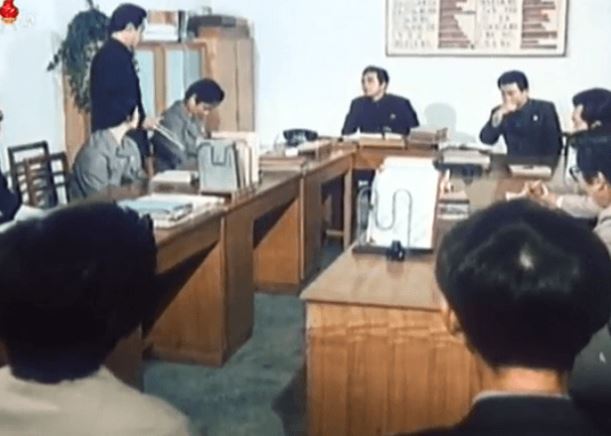
It’s a fixture of North Korean life for the entire population: the “criticism session.” Students, factory workers, farmers, and cadres alike are forced to partake in regular meetings to announce and discuss transgressions and mistakes, down to the smallest instance of failing to live up to the Kim family example. But times are changing.
The North Korean authorities have recently issued orders encouraging residents to discuss positive stories rather than dwelling only on negative information. As a result, the sessions are being seen as less burdensome, report inside sources.
“Recently, the criticism sessions organized and conducted by each organization have changed in tone and atmosphere, and residents are no longer seeking to avoid them like they did in the past,” a source in North Hamgyong Province told Daily NK during a telephone call on March 16. “The sessions used to be full of critical comments, but recently they have been encouraging residents to emphasize positive aspects.”
From the age of at least eight, North Koreans participate in compulsory sessions in which they are made to criticize themself and their peers. The meetings are carried out by a number of the country’s many social organizations, including the Korean Children’s Union, the Kimilsungist-Kimjongilistist Youth League, and the General Federation of Korean Trade Unions.
The participants each have a turn at the podium and cite clauses from the “Ten Principles for the Establishment of the One-Ideology System” and statements or writings by Kim Il Sung or Kim Jong Il, and explain how these teachings relate to mistakes they’ve made over the past week.
They are then required to elaborate on the deeper reasons for their mistakes and describe what steps they will take going forward to improve. The participants also point out the mistakes of others and must listen to criticisms from the rest of the room. This system of mutual criticism effectively makes it difficult to trust anyone.
The criticism sessions frequently cause negative social effects. Grudges between residents often deepen due to conflicts at the sessions, and some animosities have developed into violent confrontations, with one or more participants brandishing a knife. Even Party cadres are involved; their conflicts over authority and grapples for power at the sessions have made it difficult for the forums to promote group solidarity and work effectively.
“The social criticism sessions were meant to act as a form of social control over the residents, but since they weren’t very effective, there is now an emphasis being put on positive aspects,” said a separate source in North Hamgyong Province.
“As the markets have developed, residents were no longer attending the sessions with the same frequency, so this measure could be seen as a way to improve participation. It also seems like an attempt to instill loyalty under the pretext of “creating role models.”
Residents who work overseas are not required to participate in the criticism sessions.
One North Korean source with knowledge of the matter told Daily NK on March 15, “Laborers who are dispatched to Russia do not have to attend criticism sessions, and are also not bound by other controls and regulations.”
According to the source, instead of participating in the sessions, overseas workers in Russia and China are instead encouraged to spend the extra time earning money. The North Korean authorities, it seems – who once prized ideological purity above all – are now scrambling to procure funds.









