

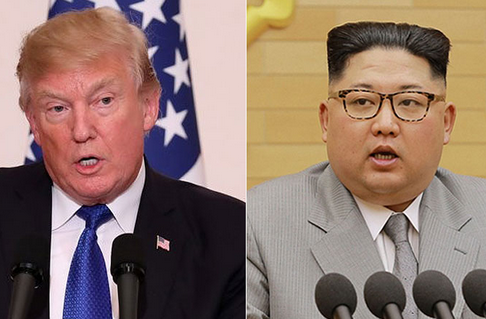
North Korean residents are holding out hope that the potential Trump-Kim high level summit, initially set to occur on June 12 in Singapore will result in economic aid from the U.S.
Asked about the general reaction of North Korean residents to the prospect of a meeting between the North Korean leader and the U.S. President in a telephone conversation on May 24, an inside source from South Hwanghae Province told Daily NK, “Ordinary people are saying there will be economic assistance from the U.S. if there is a negotiation, and are hopeful.”
“The ordinary people all know that [North Korea] is going to meet America,” the source explained.
As recently as May 15, a Ryanggang Province source informed Daily NK that “[m]ost people don’t know about the North Korea-U.S. meeting.” However, within a week, it appears that much of the North Korean population has learned about the planned meeting.
North Korea’s state media reported on May 10 that Chairman Kim Jong Un held a meeting with U.S. Secretary of State Mike Pompeo. This meeting was referred to as a “[North Korea]-U.S. Meeting/Dialogue.” It was the first time that domestic media covered a U.S.-North Korea summit.
On another note, residents are skeptical towards the North Korean authorities’ claims that they are emphasizing economic construction and development, according to the source. The residents are hopeful that aid could be incoming if the summit with the U.S. goes well, but they do not have faith in the regime’s strategy and policies to push forward economic development.
“Fundamentally, they [the residents] do not trust the Kim family. Ever since the currency redenomination in 2009, all of the residents without exception began to ask, ‘Is the country really working for us if it changes the money without the residents knowing?’ They no longer support or trust the party, nor do they want to,” the South Hwangae-based source explained.
“[The authorities] say that they are pursuing ‘Chinese-style’ reforms, but the residents all laugh at that notion. If that was true, then the border regions such as Sinuiju [a North Korean city that sits across the Yalu River from the Chinese city of Dandong] would have been designated as a special economic zone like Rason [a city on the country’s East Coast], which was totally useless,” the source added.
A source in North Hamgyong Province was also asked about the destruction of the Punggye-ri nuclear test site in the region, which saw the invitation of numerous foreign press attendees.
“The Rodong Sinmun [Party-run newspaper] said that we have completed the nuclear weapons program and achieved victory so we are discarding the nuclear [facilities]. This means that the program is complete so there is no more need [to test]. [The residents] don’t particularly care,” the source said.









