

[imText1]With the departure in Lee Myung Bak’s administration a month ahead, the footsteps of experts and NGOs suggesting a direction for the new administration’s North Korea human rights policy have been quickening.
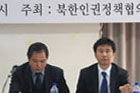
The North Korean Human Rights Policy Committee of the National Human Rights Commission of Korea held a policy forum with the theme “Discussing the Agenda and Direction for the New Administration’s North Korea Human Rights Policy” on the 10th. At the forum, representatives of the South Korean organizations for North Korean human rights criticized the “hush” human rights policy of the Roh Moo Hyun administration and urged that the human rights issue be proposed to the North head-on.
Yoo She Hee, the Director of the Network for North Korean Democracy and Human Rights (NKnet), said through his introductory speech, “North Korea’s human rights reform issue rests on the extent to which the Kim Jong Il regime shows a detailed effort for reform. Several months after the new administration, there will be resistance from the obstinate Kim Jong Il, but through domestic discussions, a strong pressure should be made.”
Ahn Byong Jick, the Chairman of the Youido Institute said regarding a direction for the North Korean human rights issue, “North Korea’s basic problem is related to the cause and effect relationships among the development of nuclear weapons, the maintenance of an isolationist regime, and the human rights violations issue. Among these, the nuclear issue is being used as the most fundamental means of maintaining the North Korean regime, so it is the most important issue.”
Sohn Kwang Joo, the DailyNK’s Chief Editor, presented, “Lessons and Evaluations from a 10-year North Korean Human Rights Policy,” and gave the assessment, “At the UN General Assembly, the international society has had a tendency to aggressively intervene in the human rights issues of individual countries, such as adopting a North Korean human rights draft resolution for five consecutive years. North Korea has also recognized these international activities as a “political problem” and has maintained that it is the largest politically subversive threat to the regime with Su-Ryeong (the supreme leader, Kim Il Sung) Absolutism.”
He also said, “The South Korean government has failed by not recognizing the North Korean human rights issue as a “fundamental right of mankind” or a love for mankind because it has treated the human rights issue as a “North-South” relations problem or an internal issue to the nation.”
Ha Tae Kyung, the representative of the Open Radio for North Korea, insisted that a “North Korean human rights bill” should be passed domestically in regards to the direction for a North Korean human rights policy by the next administration.
Representative Ha said, “The development of human rights through active dialogues should be paved through persuasion that this is the necessitous request of the era and via the pressure of international society.”
Representative Ha proposed regarding the role of China, “It opposes the proposal of the North Korean human rights issue, but has been urging the opening and reform of North Korea. The next administration needs to persuade China that it is inevitable for North Korea to improve its human rights situation on par with China’s standard.”
The vice-chairperson of the Committee of North Korean human rights of the Korean Bar Association Lee Jae Won emphasized the importance of establishing a national organization fully in charge of North Korea’s human rights, “The maintenance of a system related to North Korean human rights is necessary.”
Vice-Chairperson Lee stressed that a “Special Committee of North Korean Human Rights” under the National Human Rights Commission of Korea, a “North Korean Human Rights Headquarter” under the Ministry of Foreign Affairs and Trade or the Ministry of Unification should be established, and a “North Korean Human Rights Ambassador” should be appointed. He also suggested the enactment of a foundational law for systematization and establishment of a “consultative body” and a “North Korean Human Rights Record-keeping Center.”
Kang Cheol Hwan, the Vice-President of Committee for Democratization of North Korea, said regarding the role of civilian organizations and the plan of cooperation with the government under the next administration: ▲ increase in participation of NGOs in the North Korean human rights policies ▲ transfer of the radio broadcast project towards North Korea to civilians and ▲ the importance of systemizing the civilian role of defector rescue projects. He stressed the necessity of an alliance of NGOs to discuss regularly resolutions for North Korean issues.
Lee Geum Soon, the senior researcher for the Korea Institute for National Unification suggested the formation of a North Korean human rights team within the Ministry of Unification, “It is important to emphasize the basic reality of dignity of man in North-South relations or in diplomatic policies. All aid to North Korea should be connected to the dignity of civilians.”
The forum participants criticized the duplicity of the National Human Rights Commission of Korea which had been passive about the North Korean human rights issue. Yoo said, “The Commission which had been silent thus far started to pay attention to us” and Ahn gave a despondent smile, “I did not know that the Commission was so lofty that NGOs for North Korean human rights could have not entered easily.”
The committee member of the Commission, Kim Ho Jun, commented, “The Commission which had been passive about the North Korean human rights issue should definitely change. We will try to play a more active role than taking into consideration North Korea’s characteristics.”









