

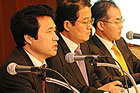
[imText1]A professor from the Korean National Defense University has raised the possibility that North Korea’s hardline domestic and international policies since the inauguration of the Lee Myung Bak administration in Seoul were based primarily on the need to firmly establish the succession system.
Professor Kim Yeon Su asserted in his speech to a February 22nd expert policy forum, “Outcome of Two Years of the Lee Myung Bak Administration North Korea Policy, and the Way Ahead,” that, “The factor that decided North Korea’s domestic and South Korea policy was the politics of succession.”
According to Professor Kim, “North Korea grew concerned by Kim Jong Il’s health problems, and sped up the political process of succession in order to establish the system earlier. As a result, North Korea took a firm political and military stance domestically, and adopted a two-faced policy toward South Korea.”
Now, he pointed out, “North Korea’s hardline bases on the domestic and foreign frontiers have become obstacles to the establishment of succession legitimacy. The North Korean authorities are facing a severe ‘crisis of faith’ in both domestic and foreign policy.”
Looking forward, Professor Kim predicted, “The successor to Kim Jong Il will continue to pursue the path of ‘nuclear capability-Military-first’ which is praised as Kim Jong Il’s premier accomplishment. The successor will adhere to socialist principles since Kim Jong Il has stated that ‘Reform and opening is the pathway to the country’s ruin.’”
“North Korea will strengthen the process of settling public sentiment over the failure of the three generation hereditary succession. Also, they will continue to try and establish the legitimacy of the succession.”
On the foreign policy front, he went on, “North Korea will induce fake nuclear negotiations and use conflict between the U.S. and China and also between the members of the Six-Party Talks to try and bring an end to UN sanctions. They will also try and get external economic support, including food supplies and cooperation.”
Closer to home, “Based on its confidence in its nuclear capability, North Korea will induce domestic conflict using the security vulnerability of South Korea. It will also attempt to weaken the ability of the South Korean government to hold the high ground in Inter-Korean relations.”
In Professor Kim’s conclusion, “The possibility of denuclearization is very low in a situation where Kim Jong Il and his successor continue to exist.”
“Three generations of hereditary succession in North Korea is a source of historical shame and an unacceptable fact. However, the South Korean government must maintain a strategic North Korea policy stance, to increase the vulnerability of the succession system’s legitimacy.”









