

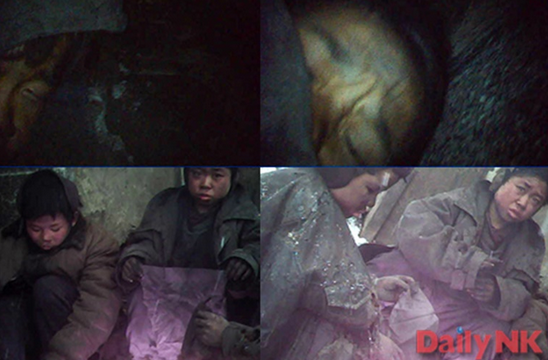
 Homeless North Korean children gather in an abandoned house in Hyesan, Ryanggang Province. Images (video grabs): Daily NK, taken in 2013 |
The North Korean authorities are now extorting homeless children for money, according to sources inside the country. These children, known as “kkotjebi” in North Korea, live in squalid conditions and do not receive support or protection from the authorities.
“The problem of pickpockets at the marketplace is severe, and you have to see the MPS as playing a role in that. They look the other way in exchange for some of the take, so residents are unable to trust each other.”
The North Korean authorities tout welfare facilities such as orphanages and boarding schools, but the problem of kkotjebi has persisted. Some donju (members of North Korea’s new elite entrepreneur class) have tried to win favor from the Kim Jong Un regime for big projects by building some facilities for these children. These centers, however, are lackluster and the kkotjebi tend to avoid them.
“It’s quite easy to see lines of young and sick kkotjebi outside restaurants, waiting to drink the watery remains of customers’ leftovers. Many residents regard these almost-skeletal children with sympathy,” a source in North Hamgyong Province said, adding that lacking good places to sleep, many gather outside apartment complexes.
According to Daily NK’s sources, the North Korean authorities are taking a passive approach to these types of social problems. Owing to a lack of interest and assistance from the authorities, North Korea’s lower class has failed to benefit from marketization, and their lives have deteriorated as a result.
“Even downtown, there are spaces for less well-off people. These are called ‘kkotjebi neighborhoods.’ The people who live there don’t get sufficient food and aren’t able to work. They live dreary lives,” a source in Ryanggang Province said.
“Seeing the North-South summit meeting, these people are especially hopeful. They are praying that rice will come quickly from South Korea to save them.”
*Kkotjebi is the word used in North Korea to refer to children who lack supervision and caretakers. In propaganda, North Korea officially states that its people are well-off and no homelessness exists in the country. The word itself is a loan word from Russia. During the famine in the 1990s, many homeless children were roaming the streets, lacking proper clothing and food. Some laborers who returned after a stint of labor in Russia referred to them in the Russian language as “kochaebiyae,” meaning wanderer. After some time, the term became a Korean loan word and the pronunciation was altered to kkotjebi (meaning ‘flowering swallows’ – a reference to the children wandering for food).









