

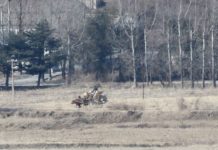

The North Korean authorities have recently ordered residents to increase their usage of ox carts instead of motorized vehicles, as it has become more difficult to source fuel in the wake of international sanctions.
According to sources inside North Korea who recently spoke with Daily NK, the price of 1 kg of gasoline in the North and South Pyongan regions is between 13,000-18,000 KPW, while 1 kg of diesel now costs 7,000-8,000 KPW. Gasoline was also reported to cost 13,000 KPW per kg in Ryanggang Province last month.
By comparison, the price of gasoline was only around 8,000 KPW per kg in March 2017. A series of UN sanctions resolutions has passed in the time since.
“Some fuel supplies continue to come in from China, but the price has gone up because there is still high demand for fuel among farmers and the military,” one source in North Pyongan Province told Daily NK on March 13.
The number of cars on the street has also declined as a result, dropping by as much as 40%, reported the source. In addition to demands by the authorities to use oxcarts, he noted that people are also “being told to boost ‘self-reliance’ by using bicycles, and to only use gas or diesel in times of emergency.”
The growing scarcity of fuel supplies has led the authorities to demand a reduction in motorized personal transportation, while collecting unused fuel for the military.
UN Security Council Resolution 2397, passed in response to the North’s “Hwasong-15” ICBM test in late 2017, is considered the primary reason for the change in fuel availability.
Resolution 2397 capped North Korea’s refined oil imports including diesel and gasoline at 500,000 barrels per year. The measure marked an even more severe reduction than Resolution 2375 which passed earlier in 2017, calling for a reduction in the annual cap on fuel imports from 4.5 million barrels to two million barrels.
Resolution 2397 also sought to restrict North Korea’s crude oil imports to a maximum of four million barrels per year.

As a result, the authorities have stepped up their emphasis on citizen “self-reliance” in an attempt to compensate for the deteriorating government services. Additional monetary requests have also been placed on residents in order to replace lost sources of funding from sanctions.
Kim Jong Un has mentioned the concept of “citizen self-reliance” in several major speeches over the last few months. During a speech given at the 2nd Plenary Session of the 7th Workers’ Party Central Committee in October 2017, he emphasized “the great spirit of self-reliance and self-development as a dynamic force and by way of science and technology.”
At the same time that fuel supplies have become scarcer and more costly, residents – including state factory and company workers, police, and state security agents – are reportedly receiving lower quantities of government food distribution.
“What used to be a 10 kg government food package for munitions factory workers and state security officials has now been reduced to just 5 kg in the spirit of ‘self-reliance,’” a source in Ryanggang Province said. “What can they do but accept it?”









