

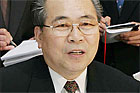
The Vice-chairman of the Central Committee of the Chosun Red Cross Society Choi Sung Ik, the head of the North’s delegation at the current Inter-Korean Red Cross talks, spoke enthusiastically in his keynote address on the 26th, “This separated family reunion will be a new turning point in inter-Korean relations and a starting point in the implementation of historical agreements between North and South.”
Chosun Shinbo, the publication of Chongryon (General Association of North Korean Residents in Japan), reported on Thursday that, according to Choi, “Independent unification and peaceful, prosperous inter-Korean relations, which were started by the October 4 Inter-Korean Summit Agreement of 2007, froze all of sudden, and family reunions stopped [due to nonobservance of the agreement]. It shows well how important the implementation of agreements made at the Inter-Korean Summits is, especially on humanitarian issues.”
The news released by the Chosun Shinbo, which is representative of the North Korean government stance, implies that North Korea is trying to take advantage of the separated families’ reunion this Chuseok (October 3rd) to urge the South to implement the June 15 Joint Declaration and October 4 Inter-Korean Summit Agreement.
The South Korean delegation reportedly did not react strongly to the statement, simply explaining, “After the North Korean delegation made its statement, there was no time to discuss the implementation of the two agreements during the talks.”
However, there is a high possibility that, after finishing the talks, when both sides try to make an agreement, conflicts will arise regarding lines about the implementation of previous agreements.
The June 15 Joint Declaration and October 4 Inter-Korean Summit Agreement cover North-South economic cooperation but do not mention any details of nuclear issues. The Lee Myung Bak administration’s stance is to join North Korea in cooperative undertakings only when Pyongyang takes verifiable measures towards denuclearization.









