

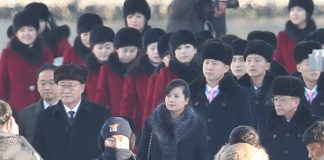

New details have emerged in relation to North Korea’s spying activities during the Pyeongchang Olympics in February and the role played by members of the cheer squad, art troupe, athletes, and other supporting members while in South Korea.
According to a high-level source inside the North Korean government, around 30% of the people who came to South Korea as part of the various groups were carrying out orders issued by the North’s Ministry of State Security. It was also revealed that many were using advanced camera equipment embedded in eyeglasses, shirt buttons, lapel pins, and watches to secretly record the activities of both the other North Koreans as well as South Koreans for later inspection.
“The North Korean authorities saw the Olympics as a valuable opportunity to collect information about certain individuals in South Korea,” the source told Daily NK on March 23.
“As there were no thorough inspections of the North Koreans or their equipment, they will likely use the same tools when crossing into the South in future as well,” he warned.
The source added that the agents focused their recording on any individual who was showing interest in the North Koreans present in any given place, especially at the Samjiyon Orchestra events and cheerleading squad appearances.
“They are currently in the middle of reviewing the pictures and videos to analyze these individuals and the circumstances of each instance,” he added.
According to a separate source in Pyongyang, the authorities attempted to boost their capabilities in this area by instituting emergency training for all young members of the technical surveillance divisions of state security before their arrival in South Korea, to ensure their proficiency in the use of secret recording devices to properly capture both video and sound.
However, he said that the government was not confident that agents without international experience would faithfully execute their duties in South Korea, and decided to recall those working in China for Olympics-related assignments instead. He reported that they recalled around 80% of their spy network from northeastern Chinese cities such as Shenyang, Dandong, and Yanji for the occasion.
“The authorities suddenly recalled the State Security agents operating in China, and then on January 24 dispatched other agents back to China who had been working internally in North Korea,” the additional source said.
“It looks like they were worried about possible defections from agents seeing the advanced developments in South Korea for the first time.”
The move reveals the regime’s continued sensitivity to both its citizens’ and agents’ exposure to foreign society and other concepts that may challenge their understanding of or loyalty to the North Korean system. It also points to the North’s limited number of trusted agents with foreign experience.
But even with their prior experience in China, the agents selected for assignments in South Korea during the Olympics were put through exhaustive training up until just before their scheduled departure.
Both sources reported that agents were not allowed access to television or newspapers during the training period lasting from January 26 until February 5, adding that there was a major focus on practical training exercises, education for behavioral regulations, and the details of their specific assignments.
The 140-member Samjiyon Orchestra comprising perhaps dozens of these state security agents then arrived in South Korea on February 6 ahead of the Pyeongchang Winter Olympics opening ceremony.









