

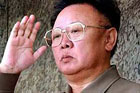
The essence of the newly revised North Korean constitution is its abandonment of communism, an emphasis on the Military-first policies, and the concentration of all powers in the chairman of the National Defense Commission.
Communism has been deleted from Article 1 and replaced with the Juche and Songun, or “Military-first,” ideologies, definitively making clear that the Military-first ideology will continue to lead the North as it moves forward. Furthermore, soldier is added to the list of three mainstays of any communist state; laborers, farmers and working intellectuals.
The Military-first ideology was an idea which emerged during the food shortages and economic collapse of the “March of Tribulation” in the mid-1990s; an emphasis on this in the revised constitution represents the North’s attempt to counter the internal and external challenges currently facing the country.
The revised constitution also describes the National Defense Commission chairman as the supreme leader of state, and says that he directs and commands all the powers of said state.
By doing so, it emphasizes the fact that North Korea considers the Military-first ideology a ruling principle, that the soldier is the core of sovereign authority and, ultimately, all authority lies with the National Defense Commission chairman. In sum, the North is proclaiming domestically and to the outside the fact that it is a country ruled by its military through the NDC chairman.
The constitution stipulates the duties and power of the Defense Commission chairman as follows: ▲ leadership over all aspects of the state; ▲ direct rule over the duties of the National Defense Commission; ▲ the designation as well as removal of key officials in the area of national defense; ▲ ratification and abandonment of key agreements made with other states; ▲ the exercise of the prerogative of mercy; and ▲ promulgation of national emergencies, wartime situations and mobilization orders.
One expert, who came from North Korea, analyzed the revised contents of the constitution for the Daily NK, saying, “It [the revised constitution] is an announcement to the international community that North Korea is a state based on its military.”
The expert stated, “To the North Korean citizens, the constitution is virtually meaningless. Mind you, the fact that the North chose to point out that the National Defense Commission chairman rules using the military-first ideology really guarantees that nuclear weapons will never be abandoned.”
Regarding a possible linkage between the succession system and this revision of the constitution, however, he was doubtful, “The succession system will be realized through a step-by-step process of approval from the Vice-Director of the Workers’ Party Guidance Department, the Military Committee of the Party and the Committee of the National Defense Commission. Thus, the actual linkage between the revision of the constitution and the succession project seems tenuous at this point.”
One member of a South Korean national policy research institution who spoke on condition of anonymity said, “The contents of the constitution are rarely revealed to or known by North Korean citizens. Among them, the Juche ideology has already become a distant memory and has been replaced by expressions such as a ‘strong and prosperous state’ and ‘Military-first politics.’”
He also noted, “The term communism ceased being used in internal lectures in the 1990s. Nowadays, North Korea is now promoting itself as a country which can realize the goal of becoming a strong and prosperous state in the not too distant future.”
The researcher, as with most Korea-watchers, was unimpressed by the addition of the expression “respect for human rights” in the revised constitution, calling it a “means by which the North is trying to show to the outside that it is a normal country.”
Additionally, he said, “Strengthening the power of the National Defense Commission and its chairman are meaningless measures as long as Kim Jong Il, who rules over everything, is alive. The revision may well serve as a ploy to safely guarantee the authority of a successor in the post-Kim Jong Il era.”









