

North Korea unleashed harsh criticism over the two joint exercises between the ROK and U.S. forces, Key Resolve and Focal Eagle, which started on the 2nd.
Spokesperson for North Korea’s Foreign Ministry said on Monday that “Key Resolve and Focal Eagle are for nuclear invasion training,” and the country will “strengthen every available deterrent.”
The spokesperson, in an interview with North Korean state media, pointed out that “the military exercises are, in both dimension and component, clearly aimed at attacking the DPRK with nuclear forces,” and “such nuclear blackmail does not work with us and only worsens the denuclearization process on the peninsula.”
“The United States, having mentioned the peaceful resolution of nuclear issues, is rather showing its consistent hostility against us by conducting nuclear exercises,” the spokesperson added.
Key Resolve exercise, which is scheduled to continue until Friday, is for ‘Reception, Staging, Onward Movement & Integration’; that is, wartime deployment of the Allied forces on the Korean peninsula. It covers mostly the southern part of South Korea. The exercise is concurrently held with the South Korea-U.S. joint drill of mobile operation Foal Eagle.
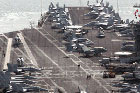
The exercise will consist of drills in manuvering emergency-deployed U.S. forces in South Korea, transporting them to the front and combining them with South Korean forces. The U.S .Forces in Korea have combined with the U.S. Army forces stationed in North America to total eighteen thousand participants. The USS Nimitz also took part in the exercises for the first time.
Last Saturday, the Chosun (North Korea) People’s Army Representative in Panmunjom also criticized the exercise, declaring “The People’s Army will not depend on defense, but will rather take the initiative with well-prepared offensive capability.”
North Korea’s quick response to the joint-exercise has been interpreted as a customary reaction. North Korea considers every ROK-U.S. joint exercise as preparation for invasion.
North Korea has argued against the continuation of the joint-exercise at every possible occasion, including the Six Party Talks and the inter-Korean ministerial talks. In 1993, at the peak of the first nuclear crisis, North Korea even declared a state of semi-warfare because of the now-terminated annual Team Spirit exercise.
Some experts have suggested the cancellation of the March 1st meeting between U.S. Assistant Secretary Chris Hill and North Korea Vice Foreign Minister Kim Kye Gwan may be related to the on-going exercises.
North Korea has never participated in the Six Party Talks while the U.S. and South Korea were conducting joint-exercises. Therefore, it is plausible that the Key Resolve exercise was the cause for the abrupt cancellation of the Hill-Kim meeting.
Moreover, the USS Nimitz visited Busan, the home of the South Korean Navy’s Operational Headquarters. A U.S. nuclear submarine and Stryker Brigades could also be seen maneuvering there.
Senior Analyst at Korea Institute for National Unification Chung Young Tae said, “It is customary for North Korea to criticize regular South Korea-U.S. military exercises. And, since North Korea is in process of declaring its nuclear programs, reaction in such forms as missile testing is hard to imagine. However, a somewhat indirect military response could be possible.”









