

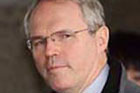
When US Assistant Secretary of State Christopher Hill visited Pyongyang to negotiate the North Korean nuclear verification regime, North Korea demanded additional rewards for allowing inspections at hitherto undeclared nuclear sites.
A source with the South Korean administration said on the 7th that “Although North Korea has talked a lot about U.S.-North Korean military talks it has not demanded them officially, but did require additional rewards for the additional inspection that the U.S. desires.”
Another source in the South Korean Ministry of Foreign Affairs relayed the news that “The North Korean Foreign Ministry demands additional compensation for accepting the U.S. requirements for the verification regime.”
According to rumors, this is because parts of facilities which the U.S. has tried to include among the items on the verification schedule are military facilities, so North Korea needs to transfer parts of those facilities to other sites ahead of the verification. The U.S. requested inspections at the suspected nuclear facility in Geumchang-ri, North Pyongan Province in 1999 and 2000. At that time North Korea succeeded in receiving 600,000 tons of food aid as compensation for allowing the inspection.
Meanwhile, in diplomatic circles a claim, that North Korea suggested U.S.-North Korea military talks and simultaneous inspections of North and South Korean facilities to Christopher Hill, has lately been doing the rounds. Chosun Shinbo, a mouthpiece for North Korean news published by Chongryon, reported that “North Korea put forward a way to solve the nuclear issue peacefully, and issued an ‘ultimatum’ [to Christopher Hill].”
However, Minister of Foreign Affairs and Trade Yu Myung Hwan has officially denied it. He explained that Hill’s visit to Pyongyang was to come to an agreement on the nuclear verification protocol, and that an agreement will be reached as long as the verification standards are not spoiled. The high ranking military officials meeting was requested by North Korea.
A diplomatic source said that “The termination of hostilities between the U.S. and North Korea and the military talks suggested by North Korea are not new requirements; they have been long set forth at the Six Party Talks.”
However, during Hill’s visit to North Korea a separate verification system was negotiated.
The “separate verification” means that inspection of the Yongbyon facilities as included in the declaration submitted to China by North Korea is first implemented and then the Uranium Enrichment Program and nuclear proliferation issues will be verified later and separately.
Minister Yu said that “All North Korea’s nuclear sites are the targets for verification, but the items which North Korea declared in June have priority over others to be verified. HEU (Highly Enriched Uranium) comes next.”
If Christopher Hill and North Korea found a compromise point on these issues, and that of additional compensation, there is a possibility that the nuclear verification negotiations could go full steam ahead from here.
It is also expected that if the U.S. governing body approves of the results of the negotiations, the result will be publicized immediately and follow-up measures will be brought forward.
On the other hand, the U.S. public antipathy can be expected because the “international standards” for complete and accurate verification may well go up in smoke, sacrificed at the altar of diplomatic fruits for the Bush administration.









