

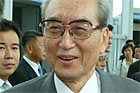
The North Korean delegation to the funeral of former South Korean President Kim Dae Jung will be led by Secretary of the Workers’ Party Kim Ki Nam, according to the Ministry of Unification in Seoul.
The delegation will be in South Korea for two days, arriving on the 21st.
Chosun Central News Agency (KCNA) reported on Tuesday that, “The delegation will visit Seoul to cherish the memory of former President Kim Dae Jung as commanded by National Defense Commission Chairman Kim Jong Il.”
Secretary Kim Ki Nam is in charge of propaganda projects and oversees historical issues. He is a close ally of Kim Jong Il, and recently accompanied the ailing North Korean leader on some official activities.
He became the first North Korean to visit the National Cemetery in Seoul when he took part in the August 15 Pan-Korean National Festival in 2005; at the time, he also visited Kim Dae Jung in Yonsei University Severance Hospital.
The remaining members of the delegation will be Kim Yang Gun, Section Chief of the Chosun Asia Pacific Peace Committee, Won Dong Yeon, Maeng Kyung Il and Lee Hyung, also from the Committee, and Kim Eun Ju, a technical expert from the National Defense Commission, according to a list provided by the Committee to the Kim Dae Jung Peace Center.
Kim Jong Il holds former President Kim in the highest regard as the person who co-signed the June 15 Joint Declaration, so it was always likely that a number of high officials would be sent.
The length of their visit to Seoul, two days, is longer than previous visits by North Korean emissaries. The North Korean delegation for the funeral of former Hyundai Group Chairman Jung Ju Young, led by Song Ho Kyung, the Vice-director of the Asia Pacific Peace Committee, stayed for just half a day in March, 2001.
Nevertheless, the Ministry of Unification spokesperson announced that no official meetings with the North Koreans were planned, saying, “They are coming only to cherish the memory of the former President. There is no other planned schedule involving us.”
Some experts suggest that the plan to send the delegation was not reported directly to the South Korean authorities, instead going directly to associates of the former President, as part of a North Korean plan to communicate with South Korean civil society while trying to isolate its administration.









