

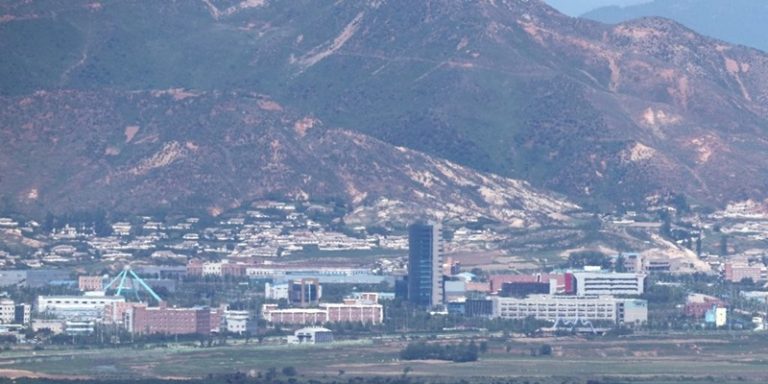
Following their adoption of a new strategic line focused on the construction of a socialist economy, North Korean authorities have recently designated Kaesung as a special economic zone “test site” and handed down orders that the area be made into an “economic development city.”
North Korea designated around 20 economic development zones across the country in November 2013 and July 2014 following the adoption of the “Economic Development Zone Law” in May 2013. This suggests that the country will be putting forth greater efforts to develop Kaesong and other designated sites.
“After designating Kaesong as an Economic Development Special Zone on June 4, North Korean authorities have ordered that detailed planning and implementation begin to create a self-sufficient, modernized, and scientifically-advanced economic development city test site,” said a Daily NK source in Pyongyang on June 28.
These orders were handed down in accordance with a decision made at the third plenum of the 7th Korean Workers’ Party (KWP) Central Committee on April 20 to focus all efforts on the construction of a socialist economy, and are aimed at the development of the “people’s economy” with a basis on bringing in outside investment.
“Authorities will make Kaesong the test site for this and all administrative elements within Kaesong will be made to look like a special development zone,” said the source. “Orders have been handed down that any buildings under three stories tall will be remodeled to have six stories or more, and the first floors of these buildings will be devoted to stores, restaurants, libraries and other cultural facilities.”
North Korean authorities will also focus on showing off the history and beauty of Kaesong with a view to make it a historical tourist site. While preserving and remodeling Kaesong’s famous historical sites such as Songaksan (Mount Songak) and Hwangjinimyo (the resting site of Hwang Jini), Party funds may even be used to create wide, spacious roads to accommodate vehicles with tourists, the source reported.
The Paektusan Architectural Institute will conduct planning activities for Kaesong’s development, while a designated team from the Ministry of People’s Security’s Administrative Office 7 will conduct activities related to construction. The source also added that financial support for the development will be managed by the provincial, municipal and county committees of the Party’s Central Committee, the Cabinet, and other organizations including the National Planning Committee.
“Orders have also been handed down that call for the successes in developing Kaesong to be used as lessons for the national bureaucracy in their own local economic development projects and for the Party to create an organization to facilitate education in this regard,” said the source.
The source explained that officials in provincial, municipal and county Party organizations have been ordered to put forth their full efforts to observe and learn from the Kaesong development model and develop the economic and agricultural aspects of the “people’s economy” in accordance with the characteristics of their own locales.
North Korean officials have also ordered the Central Party’s Organization and Guidance Department (OGD) and Cabinet to revitalize investment and tourism from South Korea in Kaesong by creating two more industrial complexes in Kaesong.
“The Party’s OGD and Cabinet have been ordered to put forth all efforts to normalize South Korean companies’ production activities in Kaesong by creating two more industrial complexes, and promote South Korean economic investment and tourism to ensure the area can again return to being self-sufficient,” a separate source in Pyongyang told Daily NK.
He explained that as efforts to establish an inter-Korean joint liaison office in Kaesong continue, North Korea has decided to establish similar local liaison offices in the country’s southern, central and western regions.
“The Party has decided to establish inter-Korean liaison offices in Wonsan (in the southern region), Hamhung (in the central region), and Sinuiju (to the northwest), along with the Kaesong liaison office,” he said.
“The Party emphasized that [South Korea’s] presence here must be shown clearly to the world.”
This development suggests that North Korea has gone one step further than what was agreed upon in the Panmunjom Declaration, which only agreed to the establishment of the liaison office in Kaesong.
The Panmunjom Declaration agreed to by the two Koreas on April 27 states that, “South and North Korea agreed to establish a joint liaison office with resident representatives of both sides in the Kaesong region in order to facilitate close consultation between the authorities as well as smooth exchanges and cooperation between the peoples.”
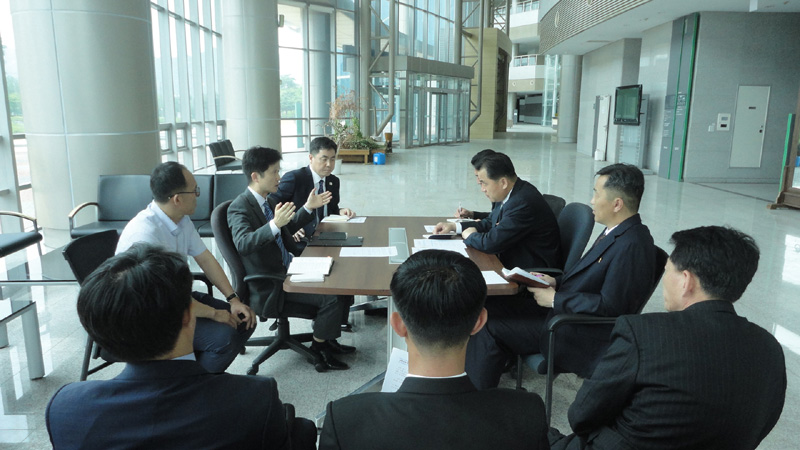
Through a high-level meeting on June 1, the two Koreas agreed to pass working-level measures to establish the liaison office in Kaesong. On July 8, Ministry of Unification (MOU) Vice-Minister Chon Haesung and his team visited the Kaesong Industrial Complex to check out the site for the liaison office, and on June 19-22 officials from the MOU and Hyundae-Asan made short trips up to North Korea to begin preparations to restore the facility.
The MOU is currently discussing plans for renovation of the liaison office site, and an “Inter-Korean Joint Liaison Office Task Force” will be created with MOU Inter-Korean Talks Headquarters Dialogue Director Lee Mu-il as its head. According to a MOU representative, the task force will include around 10 MOU members who will be divided into an On-site Management Team and General Support Team.









