

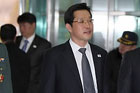
During working-level talks between South and North Korean authorities at the Kaesong Industrial Complex on March 2, the head of the North Korean delegation announced that the issue of four detained South Koreans is going to require some time to resolve, and that it is being investigated now.
Lee Kang Woo, Director General of Inter-Korean Cooperation District Support Directorate and head of the South Korean delegation, said in his statement to the North, “We would like to express our concern at North Korea’s announcement of four South Korean individuals being detained for investigation. Also, we would like to request the accurate facts of their identities, details of their entry and current circumstances.”
In response, Ri Son Gwon, a military colonel and the head of the North Korean delegation, reportedly said, “This matter is being investigated by the relevant agency and it will require some time. When a final confirmation is made, we will notify South Korea.”
On February 26, through the Chosun Central News Agency (KCNA), North Korea announced that “Four South Korean individuals whom entered North Korea illegally are being investigated by the relevant agency.”
North Korea also used the Kaesong meeting to raise issues such as the building up of tension on the west coast, distribution of flyers by private organizations and Key Resolve, a joint military exercise between South Korean and U.S. forces which runs from March 8th to the 18th. However, the South Korean delegation argued that raising such questions was unjustified in the given forum.
The talks at Kaesong were actually scheduled to discuss improvements to passage, communications and customs clearance procedures for the Kaesong Industrial Complex.
On those issues, South and North Korea apparently shared a mutual understanding, but there were differing perspectives which prevented specific agreements from being reached.
South Korea’s Lee said afterwards that “we agreed to discuss the methodology in future.”
South and North Korea agreed to divide the three agenda items into two sections for follow-up discussion: passage and customs clearance procedures, and communications.
Regarding the issue of passage, South Korea urged North Korea to implement the concept of “regular passage,” thus allowing unfettered passage at any time from 7 AM to 10 PM for persons agreed on in advance. Additionally, South Korea proposed the installation of “RFID (Radio-Frequency Identification” in North Korea during March.
On the issue of customs clearance, South Korea requested that the current system, which requires everything crossing the border to be thoroughly checked, be changed into a system which begins with 50% of cargo being checked but allows for the percentage to be reduced as time passes.
Another South Korean request was that internet and mobile phone services within the Industrial Complex be permitted as quickly as possible.
However, North Korea responded that the military assurance agreement related to issues of passage, communication, and customs clearance procedures adopted in December of 2007 requires South Korea to provide a list of the necessary facilities, materials and equipment needed for the improvements.









