

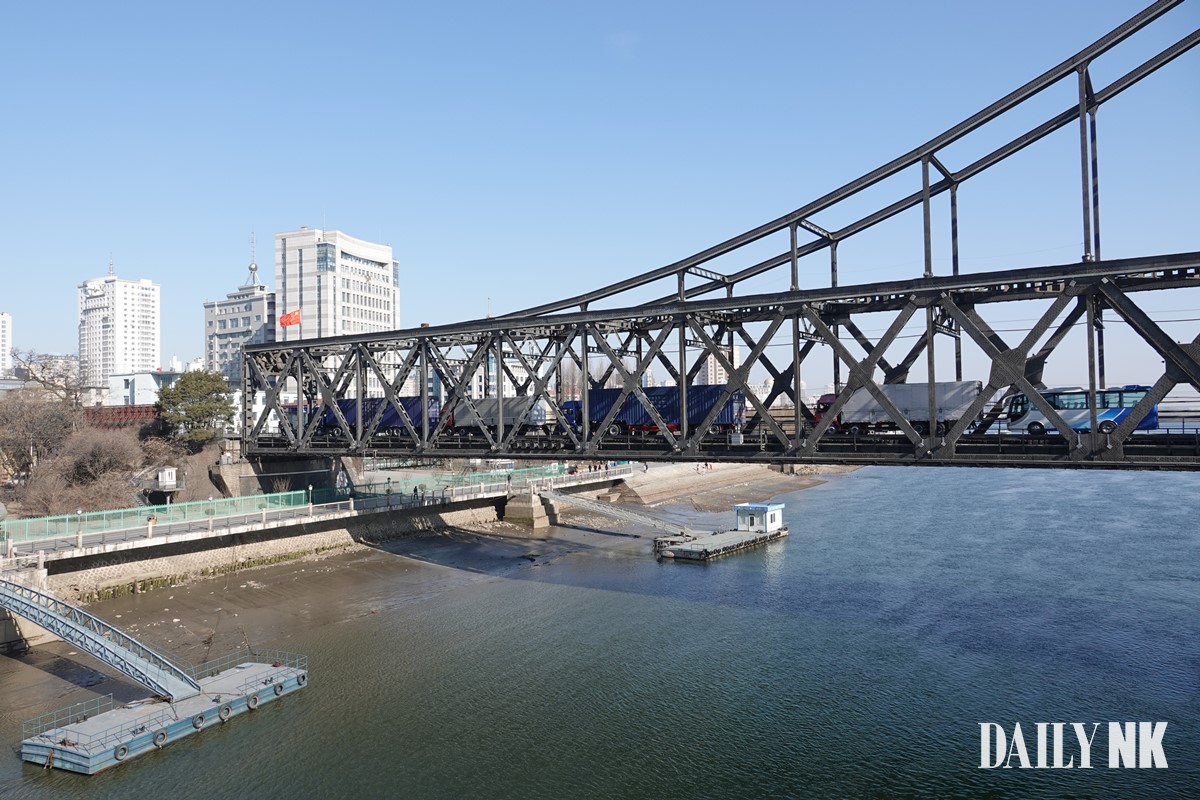
Following the resumption of freight truck traffic between Sinuiju and Dandong last week, trucks have been passing between the two cities every morning since. The trucks, however, do not appear to be loaded with official trade items.
Speaking on condition of anonymity for security reasons, a source told Daily NK on Nov. 22 that after the trade route re-opened on Nov. 13, four or five trucks have been crossing the Sino-Korean Friendship Bridge from Dandong to Sinuiju every morning, including on weekends.
On Nov. 20, for example, five freight trucks were spotted traversing the bridge headed towards Sinuiju at 10:20 AM.
The freight trucks have been loaded with suitcases and items packed in cardboard boxes, suggesting that the trucks are carrying luggage from North Korean laborers and trade workers who recently returned from China. The cardboard boxes likely contain small electronics, such as rice cookers, that workers purchased as gifts prior to their return.
When the authorities began recalling overseas workers in late August, laborers, exchange students and trade workers who had been residing in China returned to North Korea on buses and trains. Due to space limitations, luggage that could not be brought over directly is now being shipped into the country on freight trucks.
However, the freight may not be limited purely to the luggage of returning workers.
“When items are brought into North Korea, it’s not always the case that these items were on a predetermined list. While the majority of the freight is likely workers’ belongings, there may also be luxury clothing or purses destined for people in Pyongyang,” the source said.
As such, many inside North Korea do not view the recent truck traffic as an indication that overland trade between North Korea and China is likely to expand anytime soon.
According to a source inside North Korea familiar with the country’s foreign trade, “There haven’t been any instructions that suggest trade with China will be picking up. Rather, as trade with Russia increases, trade with China mostly has been centered around items the state has designated as necessities.”
The source explained that the authorities will announce their trade policies at the plenary meeting at the end of the year. Trade enterprises will then submit their import and export plans based, and this will become the basis on which trade licenses will be issued to enterprises in March of next year.
Recently, the North Korean authorities have been expanding the volume of state-mandated trade while reducing the amount of trade being carried out independently by trade institutions. As such, expanding trade avenues does not appear to be a priority or necessity in the eyes of the central government, the source explained.
The South Korean government recently confirmed that freight traffic appeared to have resumed last week at two of twelve border-crossing areas: the Sinuiju-Dandong route and the Hyesan-Changbai route.
A representative from the Ministry of Unification told reporters in a press briefing on Nov. 21 that “while it appears that the border between North Korea and China is gradually re-opening, it is too early to judge whether this overland transit will become a regular occurrence. We will continue to monitor the situation.”
Translated by Rose Adams. Edited by Robert Lauler.
Daily NK works with a network of sources who live inside North Korea, China and elsewhere. Their identities remain anonymous due to security concerns. More information about Daily NK’s reporting partner network and information gathering activities can be found on our FAQ page here.
Please direct any comments or questions about this article to dailynkenglish@uni-media.net.








