


“These days the mood in the IV Corps is completely different from what it was before 2024. It used to focus on coastal defense and holding the line against the five islands south of the sea border. Now they’ve completely overhauled the nature of the whole corps.”
North Korea’s IV Corps is overhauling its unit structure, troop deployment and chain of command in 2026. The changes follow Pyongyang’s decision to treat South Korea as one of two hostile states on the Korean Peninsula. A source inside the North Korean military says the corps is moving away from its traditional reliance on infantry. It is building up artillery, reconnaissance and drone units while reinforcing military facilities along the inter-Korean border.
The IV Corps guards the western end of the front line and is reportedly headquartered in Haeju, South Hwanghae province. Its area covers the coast facing South Korea’s northwestern islands, including Yeonpyeong and Baengnyeong.
Satellites can capture some of these changes from space in 2026. Daily NK’s analysis of satellite imagery shows coastal artillery positions and tactical roads in Kaepung county, which sits just across the Han River estuary from the South Korean city of Gimpo.
The shift also tracks the way Pyongyang has legally redefined inter-Korean relations over the past two years. North Korea revised its constitution in March to describe the Republic of Korea as a state on its southern border. The same revision also removed the earlier clauses that called for national reunification.
The source described what he had learned from officials at the IV Corps command. “They’ve completely remade it into a ‘fortified southern border against a hostile state, a fortress base for preemptive strikes,'” the source said. “Directives from the Central Military Commission keep coming down all the time. Even officers say this is no longer a standoff, since the whole front line is being reorganized to open fire at any moment.”
The Central Military Commission of the Workers’ Party of Korea is the party’s top military policy body, and Kim Jong Un chairs it.
According to the source, the corps is giving technical branches such as artillery, reconnaissance and drones a bigger share of its structure. “The biggest change is that authorized strength has jumped for artillery, reconnaissance companies and drone units,” the source said. “Fire companies used to be scattered across the infantry divisions. Now they’re being folded into artillery brigades under direct corps command or into mobile artillery battalions to concentrate firepower.”
Coastal reconnaissance posts and electronic warfare squads have also received more personnel and equipment since late 2024. More of these units now report directly to the corps operations department, the source added.
Hong Min is a senior research fellow at the Korea Institute for National Unification, a state-funded think tank in Seoul. He said North Korea is actively applying combat lessons from the Ukraine war, where its troops have fought alongside Russian forces. Units pair reconnaissance and attack drones with tanks and armored vehicles to find or suppress enemy troops before contact. Hong said this approach has already become a basic feature of modern warfare.
The overhaul does not come with an overall increase in troop numbers, however. “Total authorized strength is actually down a little from before,” the source said. “Falling birth rates mean there aren’t enough new conscripts coming in to fill the ranks. Some soldiers have also been pulled out for the engineering bureau, strategic forces, overseas deployments and construction in the rear.”
Artillery, engineering and other technical branches still get first priority when the military fills open slots. The source cited an order from the senior general staff that spelled out the new thinking. “The era of pushing ahead with sheer numbers is over,” the order said. “We must seal the defense line with firepower, reconnaissance, unmanned equipment and new strategy and tactics.”
The order suggests the corps is shifting a limited pool of soldiers toward firepower, surveillance and reconnaissance.
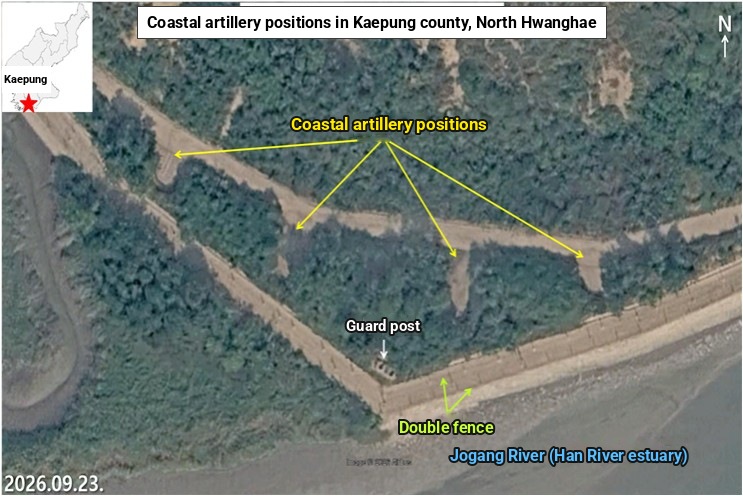
Satellite imagery shows four coastal artillery positions in Kaepung
Daily NK analyzed commercial satellite imagery and found coastal artillery positions, tactical roads and other military facilities around Kaepung county. Google Earth imagery from Sept. 23, 2026, shows four coastal artillery positions linked to roads along the Jogang River. This stretch of the Han River estuary lies opposite the Aegibong observatory in Gimpo, Gyeonggi province. Aegibong is a South Korean observation post and peace park that looks out over North Korean territory.
Each position branches off an unpaved tactical road that runs in from inland toward the riverbank. Earthen berms that appear to work as protective walls surround the positions. A double fence runs along the riverbank in front of them. A structure that appears to be a guard post stands just inside a corner of the fence.
The shape of the positions and their road links suggest they may be built for mobile artillery such as self-propelled guns. Satellite imagery alone cannot confirm what type of guns are there or how large the units operating them are. Pinning down when the facilities were first built would also require comparison with older imagery of the area.
The source said the South Hwanghae province coastline has become “one giant construction site” since mid-2024. The same goes for the Military Demarcation Line around Kaepung county, the source said. Crews are still building barrier walls, reinforcing fences, laying minefields and digging coastal gun emplacements. The authorities are mobilizing soldiers as well as civilians from nearby villages for the work.
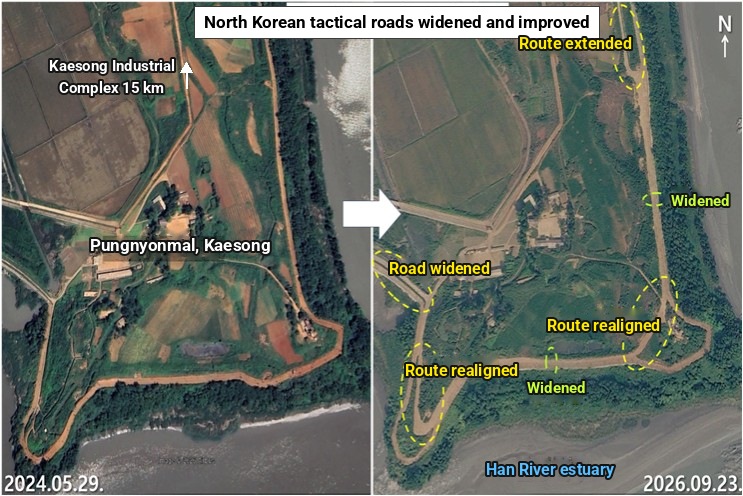
Comparing satellite images from different dates also reveals changes to military facilities near the border. Imagery from May 29, 2024, and Sept. 23, 2026, shows wider and improved tactical roads along the Han River estuary. The roads lie in the Pungnyonmal area of Kaesong, on the North Korean side of the estuary.
The western access road is now noticeably wider than it was two years earlier. Sharp curves to the southwest and southeast have been reworked so vehicles can travel and turn around more easily. Crews have also widened the sections that run along the southern and eastern riverbanks. At the northern end of the eastern road, the existing route shows signs of a new extension.
Taken together, these changes point to construction aimed at moving vehicles and equipment more easily through the border area. The road layout near the artillery positions suggests North Korea is steadily upgrading military infrastructure around the Han River estuary. Further work is needed, however, to confirm whether the roads and the gun positions belong to the same military plan. It is also unclear whether these changes tie directly to the IV Corps reorganization.
Self-propelled guns go on open display
North Korean artillery activity has also come out into the open on the western front in recent weeks. On Oct. 25, observers at the Aegibong observatory in Gimpo spotted what appeared to be three 122mm self-propelled guns. The guns sat on the Kaepung county shoreline across the estuary.
Five days earlier, on Oct. 20, Marine Corps Commandant Joo Il-seok told South Korean lawmakers that a number of changes were appearing in the IV Corps area. He made the remarks during the National Assembly’s annual audit of government agencies.
The source called the display “a mobile deployment drill deliberately aimed at the South as a show of force.” “It’s not like before, when they hid away to train in secret,” the source said. “In the past they’d throw camouflage nets over the guns and only move them at night. Now they leave the barrels pointed south in broad daylight to put psychological pressure on the other side.”
The self-propelled guns appear to be older equipment that the North Korean military already had in service. It is also unclear whether they have any link to the coastal artillery positions seen in the satellite imagery. The sighting matters less as proof of new weapons than as a sign of how openly North Korea now flaunts its firepower.
The IV Corps has also reportedly changed its commanders and the way it manages its units. “There’s been quite a lot of turnover among the commanders lately,” the source said. “Many younger officers in their mid-40s to early 50s with a feel for artillery and modern warfare have moved up. They now fill posts as division commanders, brigade commanders and chiefs of staff.”
Control over units has tightened as well, the source said. Combat commanders, political officers and security officers now face more pressure to watch one another and share responsibility. Commanders face harsher punishment than before when operational information leaks, soldiers desert or accidents involve weapons and ammunition.
The political study sessions that shape how soldiers view South Korea have changed too. “A completely new lecture outline came down for political study,” the source said. “In the past they used slogans about reunifying the fatherland. Now nobody is allowed to even say the words unification, nation or compatriots.”
The sessions now define the Military Demarcation Line as a border with a hostile state, not an outpost on the road to reunification. Instructors teach soldiers to see South Korea as their “invariable principal enemy,” the source said.
IV Corps soldiers see a permanent shift, not passing tension
Within the IV Corps, more and more people believe the changes will not end any time soon. “At first, the commanders, the soldiers and the officers’ families all thought it would blow over,” the source said. “They wondered how one people could turn into a foreign country overnight, and they blamed temporary circumstances.”
“But now they see it as a long-term military reorganization driven by new state policy under the Marshal,” the source added. North Koreans use the title “Marshal” as an honorific for Kim Jong Un.
Some officers have even grumbled that “unification is now something you’d only find in a Koguryo history book.” Others complain that “the IV Corps will be stuck forever as the shield on the front line of the southern border.” Koguryo was an ancient Korean kingdom that ruled much of the northern peninsula and Manchuria from 37 B.C. to A.D. 668.
Hong said North Korea keeps its corps structure on paper under the “southern border” approach. In practice, however, the corps is turning into a border firepower system. “They now see the zone of military confrontation as a belt with real depth, not a single line,” Hong said. “They are moving to deploy several layers of firepower inside that belt.”
He added that the front-line corps are moving away from low-precision, attrition-style firepower built around long-range artillery. They are shifting toward more precise and automated fire systems instead. Layering artillery, missiles and other weapons across the border zone marks a major change in how front-line corps use firepower, he said.
Source accounts describe a reorganization that strengthens artillery, reconnaissance and other specific branches within the IV Corps. On the ground, satellite imagery shows upgrades to artillery positions, roads and other military infrastructure in the border area.
Satellite imagery cannot directly prove specific changes to the unit structure or chain of command inside the corps. Still, the road widening between 2024 and 2026, the visible coastal gun positions and the recent display of self-propelled guns all offer important clues. Together, they point to a real shift in North Korea’s military posture on the western front. Most striking of all, people inside the corps see these changes as a lasting turn in military policy, not a reaction to short-term tension.
This article was originally written in Korean and translated with the help of generative AI tools. It was then edited by a native English-speaking editor. All AI-assisted translations are reviewed and refined by our newsroom.
Daily NK operates networks of sources inside North Korea who document events in real-time and transmit information through secure channels. Unlike reporting based on state media, satellite imagery, or defector accounts from years past, our journalism comes directly from people currently living under the regime. We verify reports through multiple independent sources and cross-reference details before publication.
Our sources remain anonymous because contact with foreign media is treated as a capital offense in North Korea — discovery means imprisonment or execution. This network-based approach allows Daily NK to report on developments other outlets cannot access: market trends, policy implementation, public sentiment, and daily realities that never appear in official narratives.
Maintaining these secure communication channels and protecting source identities requires specialized protocols and constant vigilance. Daily NK serves as a bridge between North Koreans and the outside world, documenting what’s happening inside one of the world’s most closed societies.









