

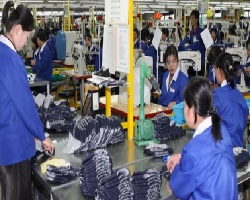
After getting word that the Kaesong
Industrial Complex is suspending operations, North Korean residents are feeling
increasingly anxious and blaming the regime, according to inside sources.
In a telephone conversation with the Daily
NK on February 12, a source from South Pyongan Province said, “Not only were
Kaesong General Market merchants distraught by the news, but so were retailers
and wholesalers of materials and products manufactured at the facility. As the
authorities tell workers to stay home and wait it out, KIC workers are
responding by anxiously posing the question, ‘How are we supposed to make a
living? After seeing the South Korean managers leave the Kaesong Industrial
Complex on February 11, they anxiously asked, ‘Who’s to take care
of our paychecks now?’”
These worries on the negative market impact stretch as far as North and
South Hamgyong Provinces and Yanggang Province, as reported by additional
sources in those regions.
Aside from Pyongyang, workers at the
complex, and by extension their relatives, enjoyed the country’s highest
standard of living. A steady paycheck, running water, and working electricity
provided favorable conditions for workers while enabling the local economy to
prosper and savings rates to grow.
“Because many of the Kaesong Industrial Complex
(KIC) workers do not have much market and trading experience outside of the
simple labor they have been trained to do, many of the families will have a
hard time adapting to economic conditions outside the KIC,” she explained.
“Cadres associated with the KIC are worried
that an extended suspension of operations will cause confusion in the markets
and even lead to an ideological backlash. If the market chaos continues, we
might expect to see someone blamed as a scapegoat.”
When asked about the residents’ reactions to
this news, the source indicated that most people, especially the donju (literally masters of money, or new moneyed class), think
that the KIC was shut down in order to block financial flows to the Kim Jong Un
regime.
“People are saying
things like, ‘Whether the market lives or dies, the Marshal (Kim Jong Un) is
perfectly willing to take the food out of his people’s hands in order to invest
in nuclear development.’ There is no way of telling what form this anger might
assume,” she said.
However, things will be marginally better for some of the sharpest vendors, who were able to
get snippets of information from cadres foretelling the closure of the KIC in
advance of the public announcement and therefore devise contingency plans.
“The merchants who were able to get this
information in advance are forming plans to work hand in hand with the KIC
cadres to buy up mass quantities of the raw materials that were left behind. Up
until now, the materials were used to make popular goods for sale in nearby
markets such as Pyongsong Market. Now, these materials will likely be sold in
bulk at high prices to donju from other
regions in order to make shoes, bags, clothes, etc.,” the source concluded.









