

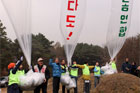
“Leaflets,” which thrived on both sides of the DMZ in the 1960s and 1970s, the era of competing political systems, have become a key issue of the digital era. This is because North Korea has pointed the finger at South Korean NGOs spreading leaflets in North Korea, using it as an excuse for threatening to restrain overland passage through the Military Demarcation Line (MLD) and the suspension of the Kaesong Industrial Complex.
After warning the South to stop spreading leaflets at the Inter-Korea military working group meeting of October 2nd, the North is now carrying out the practical protest measures it threatened.
Although North Korea has tried to subdue the Lee Myung Bak administration while urging it to implement the June 15 and the October 4 Agreements, the Lee administration did not react to it, except by suggesting dialogue. The North complained about leaflets that released the story of Kim Jong Il’s health deterioration, but it was ineffective so the North started practical moves.
The North’s countermeasures have caused complaints from enterprises in the Kaesong Complex and political criticism from the followers of the Sunshine Policy in South Korea. National Assemblymen from the Democratic Labor Party who visited Pyongyang this week warned the Lee administration to shift its policy towards North Korea.
Spokesperson for the Ministry of Unification Kim Ho Nyon stated, after the high official meeting to discuss the leaflets issue on the 19th, that “The government has confirmed that NGOs’ spreading leaflets to the North is not proper for the implementation of agreements between the South and the North and may adversely affect inter-Korean relations, so it should be restrained.”
The North’s application of pressure by using the conditions of activity in the Kaesong Complex, in which there are already-equipped facilities and the both Southern and Northern workers, as a sort of hostage is highly effective.
However, the will of NGOs involved in the leaflets issue is strong. A staff member at one such NGO stated that, “Spreading leaflets has nothing to do with the Kaesong Complex. We will continue to sending them via balloons.”
The North’s insistence stems from the “June 4 Agreement,” which was passed by the Roh administration and the North in 2004, and contained of “suspension of all propaganda activities in MDL regions,” and “suspension of propaganda attacks through broadcasting, banners, notice boards, leaflets and the spreading of all kinds of products via balloons.”
An agreement between the two countries’ governments is generally limited to what is within the remit of the government. Therefore, banning NGO activities is passing the bounds of the agreement. There is no proper legal basis to ban them from doing that, so the Southern government started examining laws handling the safe use of high-pressure gases.
However, in reality the side abusing the agreement is not the South, but the North because it has been criticizing the current administration as being run by “a rebel, Lee Myung Bak,” or a “traitor group.”
North Korea, now, has started complaining about the leaflets issue, which it had ignored while receiving cash and materials from previous Southern administrations, to the Lee Myung Bak administration.
However, leaflets scattered by South Korean NGOs within North Korea are like a tiny window for North Korean people who are completely blocked from receiving outside information. For this reason, defector organizations have been participating in this movement, and aim to continue to do so.
Of course, one thing that NGOs should keep in their minds is the target of the leaflets is only the North Korean people, not the South Korean media or people. This is not domestic propaganda. Especially in this state of negative North-South relations, NGOs could be the epicenter of a rupture in diplomatic relations.
Lee Min Bok, a representative of the Christian Defectors Association, who has been in charge of spreading leaflets for the last four years, said that, “this activity is not a political activity but a human rights movement, so NGOs should do it with sincerity.”
Therefore, NGOs need to calm down and to carry out their activities quietly and calmly so that the leaflets can continue to reach as many North Korean people as possible.









