

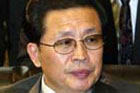
Following Jang Sung Taek’s promotion to vice chairman of the National Defense Commission in yesterday’s Supreme Peoples’ Assembly meeting, most experts agree that it has paved the way for Kim Jong Eun’s succession and allows for Jang to rule the country temporarily if and when Kim Jong Il is incapacitated.
Other experts on North Korea add that Kim Jong Il’s intention seems to be to use Jang Sung Taek as a safety pin during the succession transition.
Since the National Defense Commission has emerged as a core body above both the Party and the military, Jang Sung Taek’s appointment as its vice chairman shows that his authority has drastically expanded.
Basically, North Korea’s power should come from the Chosun Workers’ Party, but recently Kim Jong Il has empowered the NDC so the core base of authority has moved from the Party, military and the Cabinet towards the NDC.
Therefore, the NDC has become the control tower of the North Korean governing system, and of course its vice chairman holds enormous power.
Within the NDC, Cho Myung Rok is still officially first vice chairman, but he is 83 this year and cannot work due to a kidney malfunction. He has not appeared at any public event for a long time. Additionally, Lee Yong Mu, Kim Young Chun and Oh Keuk Ryeol are officially ranked higher than Jang, but they are all old and have limited roles, whereas Jang has many tasks in core positions such as being a delegate to the SPA, a member of the Central Party, Ministry of Administration of the Central Party, plus the NDC. Perhaps more importantly still, Jang is in the position of key supporter of Kim Jong Eun.
Therefore, Jang Sung Taek’s power could be seen as equivalent to Kim Jong Il’s power during the Kim Il Sung-Kim Jong Il period of joint control between 1974 and 1985.
At that time, Kim Jong Il was a member of the Central Committee, a secretary in the Central Committee, director of the Guidance Ministry, the secretary in charge of ideology and the director of the Propaganda and Agitation Department. For that reason, his appellation was “the Party Center,” which really meant Kim Il Sung’s successor.
The only difference is that Kim Jong Il made all his own decisions and issued instructions with Kim Il Sung’s tacit support, whereas Jang Sung Taek works only with the express permission of Kim Jong Il.
He has also been dismissed twice on suspicion of trying to grab power through secret political maneuvering. His position is probably therefore only a footstep for the third generation succession. However, considering Kim Jong Eun’s age and ability, the possibility that Jang may end up with more expansive powers than his No.2 position suggests cannot be completely excluded.
Professor of North Korean Studies at Korea University Yoo Ho Yul said today in a telephone interview with The Daily NK, “Kim Jong Eun has a lot of things to overcome before he can get his hands on the work of the successor due to a lack of experience and his young age. Therefore, elder statesmen or elite groups’ support will be necessary for a significant period.”
Professor Yoo implied, therefore, that Jang Sung Taek’s role will become significant, but added, “However, if Jong Eun cannot legitimize himself through Su-Ryeong Absolutism after Kim Jong Il’s death, power struggles can be expected between major elites and between departments.”









