

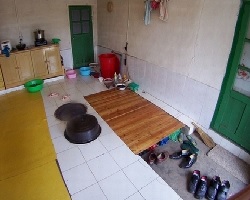
Rental fees for housing are reportedly spiking in North Korea’s cities, as living away from the family home becomes increasingly more popular amongst younger adults. Job-seekers flowing into the cities from rural regions are also adding to the trend.
“Recently, an increasing number of young people are choosing to live alone in North Korea, fueling a rise in monthly rental prices. The primary advantage for young married couples to live in the big cities is to avoid conflicts with their parents-in-law, and for individuals who are not married, to find more lucrative sources of employment,” a source in South Pyongan Province told Daily NK on October 30.
“In Pyongsong City, many younger males and females from other regions are paying monthly rent for accommodation while working as day laborers in the city. Most of them plan to spend years in such conditions earning money, before returning to their hometowns,” the source added.
Sources in North Pyongan Province and North and South Hamgyong Provinces reported these trends to hold true in their respective regions as well.
Living alone in North Korea was uncommon in the past for young unmarried women, due to the deeply-rooted patriarchal culture. However, attitudes appear to be progressively changing.
With the rise of marketization, the perception toward these independent women has become positive, and in contrast they are now more regarded as competent and contemporary women. “They are now perceived as independent, strong, and more financially stable individuals, which also makes them attractive for marriage,” the source noted.
“Landlords these days prefer to rent their houses to single women than to families, because even though the rent fee is the same, women tend to cause less trouble in terms of water consumption and toilet usage, and they are also much cleaner.”
In North Korea, residents rent out parts of their houses by offering unused rooms or adding new rooms to the house. Although the renting is technically illegal in North Korea (meaning that all transactions are on the black market), crackdowns on these activities are relatively uncommon as the state is unable to provide enough accommodation for its citizens. In most cases, if the rent-payers complete the change of abode documents from the migration office and submit them to the regional inminban (people’s unit) and security agency (police), there are no issues.
Rental properties are also favored by newlyweds who are financially stable, as a rising number of young adults seek to enjoy life away from the constraints of their parents.
“Young married couples in the cities consider it more viable to save money while living in rental accommodation than to live with their parents-in-law. As the number of independent couples increases, the construction market for housing and extension projects in the cities is also gaining momentum,” the source added.
Rent fees vary widely depending on market accessibility and proximity to transportation. In addition, the size of the lodging and quality of the interior (including bathroom, entrance, and plumbing) also affects the price. A separate source in North Korea further confirms that, “The average monthly rent fee in the Pyongsong City area is approximately 150,000-200,000 KPW [18-25 USD] for eight pyeong (with 1 pyeong equivalent to approx 1.2 square meters) for houses with good access to the markets.” Considering average prices in North Korea, a typical rental fee is enough to buy 1 kg of rice (5000 KPW) every day.
“A new trend is that residents are renting out their houses without the help of middlemen to make more money. The landlords ask their tenants to pay the entire rental fee upfront upon moving in, without making a formal contract,” the source noted.









