

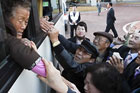
The latest round of separated family reunions has revealed to the world four Korean War veterans logged by the South Korean government as killed in action being reunited with family from South Korea.
The four individuals, Lee Jong Yeol, 90, Lee Won Jik, 77, Yoon Tae Young, 79, and Bang Young Won, 81, were not previously on the South Korean government’s list of approximately 500 POWs thought to be living in North Korea.
An official with the Ministry of National Defense stated on October 31st, “According to the statements of North Korean defectors and returned South Korean prisoners, residing family members and servicemen from the same unit, we estimate that approximately 500 South Korean POWs from the Korean War are living in North Korea.”
The future status of the four confirmed as alive by this reunion event will be determined according to the will of the families after the current reunions have been completed.
Meanwhile, the South Korean government is planning to re-examine the status of South Korean prisoners of war in the light of this embarrassing revelation. However, since the Ministry of National Defense only amends the list as the truth is confirmed via statements from North Korean defectors or returned South Korean prisoners, the cooperation of the North Korean authorities would be essential for any substantive progress to be made.
“North Korea’s cooperation would be mandatory for an accurate investigation; however, since North Korea denies the very existence of South Korean prisoners of war, it is difficult for us to obtain such help,” the Ministry of Defense official explained.
Including four South Korean prisoners of war on the reunion list while insisting more generally that there are no South Korean prisoners of war in North Korea is likely to have been a political act designed to generate interest from South Korea.
This is not the first time that South Korean prisoners of war have been included on a North Korean list of separated families. One South Korean prisoner of war appeared at an event last year, while during the 18 previous reunion events the phenomenon has been reasonably common. However, these four men are not in good health, and this is being seen as designed to convey a certain message to Seoul.
For example, Lee Jong Yeol has a problem with his leg due to a bullet wound he suffered during the Korean War, and has lost the sight in one eye. In addition, Lee’s family says that his wavering voice and blurred memory are due to a stroke.
“His health condition was not good as his memory is wandering. We are very concerned,” Lee’s family explained later. North Korean medics were close at hand during the event.
Meanwhile, the South Korean government has now also classified abductees (both during and after the war) as “special separated families” alongside prisoners of war and started to include them in the reunion events. Indeed, both South and North Korea included more people on their lists of approximately 500 individuals than on previous occasions.
Perhaps in an attempt to create a climate of compromise, the Ministry of Unification has also requested that the expression “separated family of former South Korean army serviceman” be used rather than “South Korean prisoner of war”.
At a Red Cross conference held at Kaesong on October 26th and 27th, North Korea requested 500,000 tons of rice and 300,000 tons of fertilizer as a precondition to considering making reunions of separated families a regular event, as per South Korea’s wish.









