

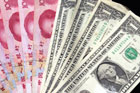
Following North Korea’s currency redenomination, domestic use of foreign currency was made illegal, and the state is now trying to enforce what can be called a “foreign exchange concentration system,” placing access to foreign currency entirely in its own hands. However, economists say that such a policy will only increase the value of foreign currency in North Korea over time, as Koh Il Dong, Senior Research Fellow at the Korea Development Institute (KDI), explained in his recent report, ‘Ripple effect and outlook for North Korea currency swap and par value unit change,’ published in KDI Review of the North Korean Economy.
“Currently, North Korea is trying to utilize a strong foreign exchange concentration system,” Koh explains in the report, “However, since the domination of the dollar is already rampant, the question lies in whether such dirigisme will have any effect.”
A “foreign exchange concentration system” is a system in which it is mandatorily required for local residents and corporations to sell to or deposit their foreign currency reserves in a bank or with the state, theoretically in order for the state to distribute foreign exchange reserves most efficiently.
Koh explained that, under this system, “All foreign currency is mandatorily required to be exchanged for North Korean currency. Even foreign visitors are making payments for goods and services with North Korean currency now.”
However, he explained, “The legal tender of North Korea, in which the people have already lost trust due to continuing high rates of inflation, has actually lost its status even more following this measure, the practical demand for foreign currency will have increased, and if North Korea continues to implement a strong foreign exchange concentration system, it will increase the ‘risk premium’ of foreign currency and increase its market price.”
The vast majority of consumer goods sold in North Korea are imported from China. The market price in North Korea is arrived at from the market exchange rate coupled to the Chinese market price plus a profit margin. Therefore, a fluctuating exchange rate in future will be directly incorporated into the market price.
Koh anticipates that the ultimate victims of the decree prohibiting foreign currency usage will be the nouveaux riche who have accumulated considerable wealth by colluding with the authorities. As a consequence, he expects strong resistance from this group, but, as he also points out, “If the regime turns a blind eye to them and allows them to possess or distribute hard currency, the dual structure of the North Korean economy will deepen. The disappointment and frustration of residents will be amplified in that case.”
“Generally, currency redenomination can achieve a desirable result when prices are stabilized for some period of time by a reliable macroeconomic policy,” Koh concedes, however “the current economic situation of North Korea is somewhat different. Price uncertainty has already taken hold in the everyday lives of residents. If the North Korean regime fails to take on the distribution function of the market, there is a high possibility of more severe future instability in the North Korean economy.”
Meanwhile, Koh stated that, based on the policies of the North Korean government from the currency swap until now, considerable resources are being expended to restrain market activity.
Not only that, but, as The Daily NK has reported, “North Korea is providing monetary compensation to workers and farmers who conform to the existing system in the form of salaries and bonuses, to avoid the dissension of classes from within the system.”









