

In the midst of the Lee Myung Bak administration adhering to the “Ask first, then we will send aid,” North Koreans related to South Korean projects in North Korea are maintaining the position, “If they give aid, we will receive, but we will not ask for aid.” The tug-of-war between the North and South seems to be continuing.
”Yonhap News” reported on the 18th that according to experts on North Korea who recently returned from visiting the North, North Korean persons concerned with the South, such as the United Front Department and the Korean Council for Reconciliation and Cooperation revealed, “If the South gives food aid, there is no reason to refuse it, but we will not ask first.”
Our administration has repeatedly expressed the principle, “Ask first, then we will send aid.” A person at the Ministry of Unification said on the 18th, “Our government has not expressed any change in the principle, ‘we’ll examine when the North makes a request’ and the ‘request of the North’ remains the basic condition for food aid to the North.”
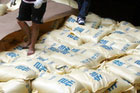
Conversely, with the U.S. administration officially announced its plan to send 500,000 tons of food aid to North Korea, the immediate reaction from the North Korean media, and the opportunity to reach a compromise on the nuclear reporting issue, U.S. food aid to the North has been riding a rapid current.”
North Korea, within 12 hours of the U.S. Department of State’s announcement of the food aid plan on the 17th, relayed the following through the first broadcast of the Chosun (North Korea) Central News Agency, Pyongyang Broadcast, the state-controlled radio broadcast Chosun Central Broadcast and the Chosun Central TV Broadcast.
The North Korea media publicly reported, “It will aid the resolution of the food crisis” and “(U.S.-North Korea) confidence/trust will increase.” Such an expression of gratitude, albeit in a roundabout way, is unprecedented. It can be analyzed as a suggestion of North Korea’s intent to improve relations with the U.S.
Also, North Korea’s move can be interpreted as an effort to exaggerate the improvement in U.S.-North Korea relations with North Korea’s initiative and to give “hope” to the struggling citizens that food will soon be arriving.
In contrast, the North has maintained an aggressive stance towards the South Korean administration. Lee Chung Bok, the Vice-Chair of the Korean Council for Reconciliation and Cooperation in the North’s side, insisted to the South Korea’s former Minister of Unification Jung Seh Hyun, who recently visited the North, “If the highest South Korean official announces the implementation of the June 15th Joint Declaration [signed directly by Kim Jong Il], the stalemate will be resolved.”
Related to the taut tug-of-war between North and South Korea, experts took up the position of the importance of the South Korea’s new administration keeping the food aid principle. In the face of North Korea keeping an aggressive attitude, it has been pointed out that there is no need for the Lee administration to bend its neck first.
Yoo Ho Yul, a Professor at Korea University, said in a phone conversation with the Daily NK, “Our government has to make a move after watching the progress in the Six Party Talks, which will resume shortly. The U.S. coming forward for food aid will damage the principle of its North Korean policy and it will only be dragged around by the North, if the Lee administration follows the food aid policy of the U.S. without the principle.”
Professor Yoo forecasted, “The Lee administration will not officially offer its hand to the North first. Currently, the matter will neither be of urgency to the North, since it is engaged in exchange with China and food is coming in from the U.S.”
He warned regarding North Korea’s request of the implementation of the June 15 and October 4 agreements, “While it shows the North’s intent to have a document signed by Kim Jong Il be acknowledged, economic gains has simultaneously been taken into account. Our government, while responding flexibly, has to keep the principle of ‘Ask, then we’ll support.’”
Song Dae Sung, a Security Researcher at the Sejong Institute, emphasized, “To the extent that the Lee administration has revealed practicality, productivity, and cooperation of citizens as the principle of North-South Korea relations, if our government shows concern first, then the principle will naturally become weakened.”
Researcher Song added, “If aid to North Korea resumes while North’s attitude does not exhibit any change, it will not take the South seriously. Aid has to be sent on the condition that transparency in the division and an organized system are preserved.”
Yun Duk Min, a researcher at the Institute for Foreign Affairs and National Security, explained, “North Korea has dosed the urgent fire ignited by food aid by the U.S. The North seems to have acknowledged our proposal ‘if there is a request’ as the ‘pre-condition’ and seems to be harboring an offended posture.”
Professor Yun added, “North Korea must have evaluated that our side will shortly resume food aid. We should also refrain from using food aid or the North Korean nuclear issue as a leverage stick in North-South Korean relations.
Professor Yun finally stressed, “Regarding the request made by the North regarding the June 15 Declaration, our government does not need to respond.”









