

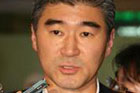
Media reports of an anticipated second visit to North Korea by Sung Kim, director of the Korea Office at the State Department, on May 5th to further discussions on North Korea’s nuclear declaration have proven false.
It was also reported that the U.S. and North Korean delegates to the Six Party Talks would meet once more at ASEAN Regional Forum (ARF) in Singapore, depending on the outcome of Kim’s May 5th visit to Pyongyang.
Further, diplomatic circles in Washington D.C. had predicted that a concrete agreement would be discussed at the Pyongyang meeting regarding fine-tuning the declaration of nuclear programs and the subsequent verification process.
Although both sides have agreed that items related to plutonium production should be clarified in the declaration, there are still subtle disagreements between them as to how these items are to be documented. Diplomats have made the observation that there is a need to guarantee the accuracy of the Yongbyon records North Korea has agreed to submit.
Several reports suggested that Kim would likely communicate to the North about the skeptical atmosphere within the U.S. Congress that has loomed following the Bush Administrations presentation of evidence regarding the North Korean nuclear connection with Syria, and the administration’s intent to proceed with nuclear negations despite this.
Following Sung Kim’s rumored visit to Pyongyang, North Korea was expected to submit a declaration to the chairing country of the Six Party Talks, China. The declaration will be to include: North Korean facilities related to the production of plutonium, the total amount of plutonium North Korea has extracted so far, and the record of operations at the 5 mega watt Yongbyon Reactor site.
The Yongbyon nuclear reactor records are predicted to be used as a primary source for verifying the amount of extracted plutonium, which is the life blood of North Korean nuclear weapons. North Korea assured Sung Kim during his last visit to Pyongyang in late April, that the records would be submitted.
A count of North Korea’s nuclear warheads, which has been requested by the U.S., is not required for the declaration. However, experts believe that the number of nuclear warheads and explosive devices can be estimated, as long as North Korea submits complete and accurate records showing the amount of plutonium produced and its current usage.
Regarding Uranium Enrichment Programs (UEP) and the suspected nuclear connection with Syria, both of which are major obstacles to proceeding onto the third phase of the denuclearization process, the U.S. and North Korea agreed at the Singapore Meeting on April 8th that the two issues would be addressed separately through a memorandum of understanding.
Therefore, according to predictions, if a final blue print of the declaration were to have been agreed upon on May 5th, North Korea would have likely soon after have submitted the declaration to China, and the member countries of the Six Party Talks would have gone forward to review it in turn.
A South Korean government source offered that the Six Party Talks will likely resume in late May, if no conflicting factors arise.
North Korea and the U.S. have agreed that the U.S. will remove North Korea from the list of terrorism-sponsoring countries and that North Korea will demolish the cooling tower of the Yongbyon 5 mega watt nuclear reactor in a day, a milestone of the disarmament process, after the member countries of the Six Party Talks approve the final declaration.
The member countries will subsequently correspond with the North’s pro-active measures by supplying energy aid and other forms of aid and by commencing with the verification of the nuclear declaration. After this, the 3rd phase negotiations for the denuclearization can begin.
Regarding this procedure, Yoo Ho Yul, a professor of Korea University, said in a telephone interview with Daily NK that “The declaration of North Korea’s nuclear programs was already nearing completion by the time of Sung Kim’s last visit to Pyongyang. This second visit to Pyongyang would have been more of a gesture to symbolize final negotiations, much like the demolition of the Yongbyon cooling tower.”
He emphasized that “If North Korea submits the Yongbyon operation records, there will be no additional arguments made.”
To the contrary, Kim Tae Woo, a researcher of the Arms Control Studies Division at the Korea Institute for Defense Analyses, said that “The declaration of plutonium programs negotiated by the U.S. and North Korea is not so simple an affair. There are still some parts that need to be argued.”
Kim added that “The total amount of plutonium reported by North Korea differs from U.S. estimates. At this time, the U.S. will try to reach an agreement.”
Last November, North Korea reported the amount of extracted plutonium as totaling approximately 30kg. This sharply contrasts U.S. estimates, reported at around 50kg of plutonium.
Kim Tae Woo asserted that “North Korea’s demolition of the Yongbyon cooling tower will be nothing more than a symbolic gesture. It has no significance. The key is the accuracy of the Yongbyon records, which are expected to be submitted by North Korea. There is still doubt as to whether North Korea will faithfully report on the operations.”
The U.S. Department of State has denied reports of a second vist to Pyongyang by Sung Kim. During the U.S. Department of State press breifing on May 5th, Deputy Spokesman Tom Casey confirmed that “[Kim] is here in Washington today,” not in North Korea as reports had suggested. He affirmed there there is not plan at present to send Kim to North Korea and that the State Department would simply “see what comes up.”
Radio Free Asia (RFA) had also reported on the 5th that Sung Kim was expected to visit North Korea that day in order to tie the Japanese abduction issue with the nuclear declaration issue. The RFA quoted one U.S. diplomatic source as saying that during the Singapore Meeting, Christopher Hill informed Kim Kye Gwan that North Korea’s handling of the Japanese abduction issue needs to coincide with negotiating a settlement of the nuclear declaration.









