

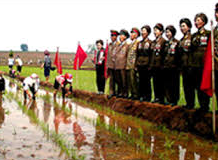
University students mobilized for rice farming duties in
North Korea’s farmlands are toiling for 14 hours each day under strict
surveillance and control. Selected students have been designated as “group
cadres” to monitor their fellow students, sowing discontent arising from the
vastly disproportionate workloads.
“Students have been mobilized for farm support work for more
than 14 hours each day beginning at 6 am and ending at 8 pm,” a source from
North Hwanghae Province recently reported to Daily NK. “Some are complaining
that they’re being treated as if they’ve committed a crime and have been sent
to a labor-training camp.”
Additional sources in the same province and South Hwanghae Province verified this news.
“For the most part, the farm workers on site are too weak
from malnourishment, so they mainly act as guides,” the source said. “Also,
students have to take on the workload of the student cadres who only monitor
people and don’t help with the farming, so they wrap up their day after the sun
goes down.”
North Korean universities have multiple organizations and
disciplinary bodies tasked with monitoring students. Children of Party cadres
or donju [newly affluent middle class] are typically the only ones able to get
into these organizations.
“Around 25% of the entire student population is in charge of
watching others, 35% escape mobilization using bribes or connections, and the
remaining 40% are the students with no influence that are working on the
farms.”
Most of the students in the worker contingent are children of laborers and farmers
in the North, and this often leads to complaints about having to “slave away”
while others relax, the source added.
The state is ultimately the cause of such class divisions
even among fellow students. The categorization of its residents into core,
wavering, and hostile groups as well as oppressive monitoring is reflected
directly in the student demographic as much as it is in the broader population.
In the midst of this, the recently launched “200-Day Battle”
has triggered greater animosity among students, leading to criticisms of the
regime for issuing year-round successive mobilization orders. Concerns are
mounting over the human cost of such extended and strenuous mandatory labor
requirements.









