

The analysis has been proposed that North Korea’s repeated urging of the implementation of the “June 15 Joint Declaration” and the “October 4 Inter-Korea Summit Agreement,” while continuing the slanderous offensive towards the South through the media recently, is related to the North’s desire to maintain its regime’s distinctness, economic gain, and the leadership in North-South Korean relations.
North Korea has been emphasizing the implementation of the above declarations, since the Lee administration’s policy towards North Korea became formalized through the report on operations of the Minister of Unification. Recently, when the North refused President Lee’s proposal to establish a permanent North-South Korean Liaison Offices, North Korea required President Lee to reveal his position regarding the two declarations first.
On the 26th, North Korea said through the Party publication Rodung Shinmun, “The South has to take a proper position regarding the June 15 and the October 4 Declarations.” On the 29th, it insisted, “The declarations cannot become political bargains and even though a political racketeer have disallowed this, the historical meaning of the accomplishment cannot be destroyed.”
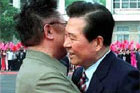
The reason why North Korea is emphasizing the implementation of the two declarations is related to the distinctiveness of the North Korean regime. The first reason is that the declarations are documents directly signed by Kim Jong Il, North Korea’s great leader, at the 1st and 2nd Inter-Korea Summit Talks.
A researcher at the Korea Institute for National Reunification, Park Young Ho, said in a phone conversation with the Daily NK, “From North Korea’s position, the June 15 and October 4 Declarations have been advertised as the achievements of Kim Jong Il, so there is no choice but to stress why the agreements that the General made have not been kept yet.”
Jung Hyung Geun, the Committee Member of the Grand National Party and who is a well-informed person about North Korea, said on the 30th, “The declarations are the agreements of Kim Jong Il’s era, so the lack of acknowledgement by the Lee administration is understood as the administration’s resolve to not recognize Kim nor engage in dialogue with him.”
Also, it can be analyzed that the reason for North Korea’s emphasis on the implementation of the declarations is due to its intent to not lose the leadership in North-South Korean relations. When the Lee administration took initiative in the relations by proposing the establishment of a liaison office, the North launched an offensive.
Senior Researcher Jung Sung Hoon at the Korea Institute for National Unification analyzed, “It must have recognized, when the proposal for liaison offices was made, that the Lee administration had the “intent to engage in dialogue,” hence its gesture to lead a dialogue in the Lee’s way. In particular, it expressed the refusal of the “Denuclearization and Opening 3000” plan, saying, “Keep the promise of the previous administration first.”
North Korea strictly emphasizes “Uriminjokkiri (Amongst Our Nation)” in North-South Korea relations. It emphasized that it is preserving nuclear weapons as a deterrent against the U.S.’ nuclear strategy and has approached the nuclear issue by separating it from the North-South Korea issue. It has shown a strong reaction of discomfort towards the South Korean administration, which put forward ‘denuclearization’ as a precondition, and has emphasized the two declarations which stress reconciliation and cooperation
Further, economic gains from the implementation of the declarations must have been considered. The declarations can be the source for partly overcoming the economic crisis as a result of North Korea’s isolation, but due to the Lee Myung Bak administration’s negation, North Korea has ended up in an awkward situation.
Researcher Park said, “The declarations are considerably beneficial agreements to the North. It is not surprising that the North is urging their implementation, where immediate gains are expected.”
With growing resistance from North Korea, The South’s administration is reviewing the position regarding the two declarations. It has stepped up to find a solution to inter-Korea relations, which has been in a stalemate after the announcement of the Lee administration’s policy on North Korea and the nuclear issue.
The Minister of the Unification Kim Ha Joong said on the 28th, “There are a lot of things that have been implemented through the two declarations. Against the backdrop of reality, we expect to move forward in reviewing plans of implementation that will be feasible to achieve through negotiations under the mentality of mutual respect.”
A related person of the administration said, “We will send another message to negotiate and to hold a North-South Korea dialogue. The October 4 Agreement should not just be implemented verbally, but we must ask hard questions to the North through actual dialogue.”









