

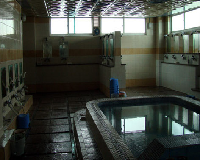
With winter in full swing, bath houses run
by the new affluent middle class donju are gaining great popularity. Despite massive state-run baths known as ‘Eundeokwon,” which boast elegant decor
inside and out, their poor hot water supply deters most people from stepping foot inside, Daily
NK has learned.
“Small cities have flashy Eundeokwon bath
houses that come with hair salons, and facilities for drinks and food, but no
one really goes there,” a source from North Hamgyong Province told Daily NK on
Monday. “Most people go to smaller baths run by donju instead.”
Sources in Yanggang Province and South Hamgyong Province confirmed this to be the case in their regions as well.
“At the state-run baths not only do you not get hot running water, you have to
wait shivering in the cold while the water is heated up in a 10 liter bucket
set on a small coal burner,” she explained. “But the private (i.e. donju-run) baths come
with saunas and proper hot water bath areas, so there’s an endless stream of
customers.”
Another factor that repels customers from
public baths is the smoke and stench coming from the coal burner, which is why
most people do not go to Eundeokwon if they can help it. Private bath houses
use oak fireplaces instead, ensuring hot water is always ready. The
temperatures are so high the heat can get “suffocating,” according to the
source.
Despite the slight drop in wood prices recently, state-run and donju bath houses in the northeastern regions of North Korea both predominately rely on timber from the markets as fuel. To cover the fluctuating price of wood and transportation costs, state-operated bathhouses recently bumped prices up from 200 KPW to 500 KPW [0.02-0.06 USD] for communal baths and from 1,000 KPW to
1,500 KPW [0.12-0.17 USD] for personal ones.
“Compared to Eundeokwon, the prices at
donju establishments are 1,000 to 1,500 KPW [0.12-0.17 USD] more expensive but you can enjoy a
much cleaner bath,” she asserted.
These private baths are commonly frequented
by donju and cadre members who often come with their mistresses. This is
because at public bath houses, customers are required to present their national
IDs unlike at donju-operated facilities.
“The private baths that are located in
areas without a lot of people at night even hire one or two female
scrubbers usually around 17 or 18 years of age, which is why a lot of donju go
at late hours,” the source said. “People pay for their baths, and if they
request skin scrubbing services, a scrub mistress will enter the personal bath
after about 20 minutes and provide this service.”
This additional service comes with an extra
20,000 KPW [2.3 USD] fee, and women scrubbers are often given a 10,000 KPW tip. “This is
becoming a new trend, so now many private bath houses are out to hire female
workers,” she concluded.









