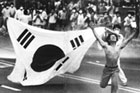
The June Democracy Movement in South Korea was a nationwide period of pro-democracy protests between June 10th and June 29th, 1987. For the better part of a month, citizens protested against both former President Chun Doo Hwan’s attempts to protect the constitution in order to maintain indirect president elections and the deaths of Seoul National University student Park Jong Cheol and Yonsei University Student Lee Han Yeol.
Park Jeong Cheol was arrested in 1987 and died on January 14th after being tortured because he refused to reveal the whereabouts of one of his university seniors, Park Jong Woon, who was also a leading participant in the students’ movement. Grasping this opportunity, condemnation of the government and resistance to the indirect electoral system grew. The police initially tried to cover up the cause of Park’s death, saying that an investigating officer had “banged” the table with his fist while questioning Park about the allegations, and that Park had fallen down, gasping.
When it was revealed on May 18th that Park’s death had been covered up, demonstrations demanding democracy happened across the country. A tragic but critical boost to the movement occurred when Yonsei University student Lee Han Yeol was critically injured by a tear gas canister on June 9th.
The uncontrollable demonstrations only stopped once Roh Tae Woo, by then the leader of the Democratic Justice Party through which Chun Doo Hwan had ruled, announced eight measures including the introduction of a direct electoral system.
The June Democracy Movement was the moment when the concept of democracy took root in South Korea and authoritarian rule came to an end. Also, it was used as an opportunity to develop democratic institutions across all levels of society.
The June Democratization Movement of 1987 is different from existing pro-democracy rallies, first because it was a call for democracy from people living under military rule, and second because ordinary office workers, the so-called “necktie corps,” actively participated in the demonstrations.
Ironically, however, the movement was not just a defining moment in the development of democracy in South Korea, it was also a chance for a pro-Juche organization, the “National Liberation Group” (NL), to expand nationwide.
Among student activists at the time, the NL group, which was avowedly anti-American, appeared more aggressively radical than the People’s Democracy group (PD). The PD group initially grasped the popular initiative by combining with the opposition Unification Democratic Party and arguing for a direct electoral system. They called for a constitutional assembly to be summoned. Their strategy of supporting amendment of the constitution and the creation of a direct electoral system was supported by North Korea.
But the NL group spread across major university campuses nationwide thanks to the June Democracy Movement, gathering a base of support at once and reducing the support of the PD group. Thereafter, the PD group gradually lost its meaning following the decline and collapse of communism in Eastern Europe, meaning that the era of NL monopoly could begin.
Soon enough, however, the NL group showed signs of decline as democracy developed in South Korea, but thanks to the Kim Dae Jung administration’s Sunshine Policy the group experienced a resurgence.
This is the historical background as to why the early 2000s South Korean society led by these people as 30-somethings had such strong pro-North Korean, anti-American tendencies. Known as the “386 Generation,” they were born in the `60s, entered university in the `80s, and were by this time in their 30s.
Kim Joo Sung, a Professor of Korea National University of Education assessed the situation, “Among the leaders of the June pro-democracy resistance movement, students of the 1970s like myself fought for liberal democracy, but students of the 1980s were fighting for socialism… The problem was that in 1989~1990, communism in Eastern Europe collapsed and their dream disappeared. In the end, Juche nationalism was all that was left, and it continues to influence society.”
According to the 2008 World Democratization Index produced by The Economist, South Korea is 28th and North Korea is 167th out of 167 countries. North Korea has become a worldwide concern after failing to escape from one-family rule after more than 60 years and because of its focus on the development of nuclear weapons.
And yet, many of the 386 Generation still operate under the contradiction of harboring greater resentment toward the Lee Myung Bak administration than toward North Korea.
In today’s situation, when the spirit of the June Democracy Movement still fails to encompass the human rights of the North Korean people, Hong Jin Pyo, Secretary General of Liberty Union for New Korea, said of the 386 Generation, “If they discuss North Korea’s human rights or democratization, they believe that it means they are helping the right-wingers.”
A little self-reflection is needed on all sides.
Professor Kim commented, “Extreme conservative right-wingers and ‘new-right’ groups are becoming more flexible in order to achieve true liberal democracy. However, on the left, extreme conservatism is stronger. The extreme conservative left-wing, in which revolutionary elements hide, needs to change its mindset. They need to develop a win-win competitive relationship with the right rather than becoming a militant movement.”