

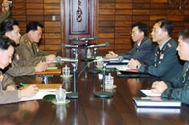
[imText1]It was revealed that on the 2nd, North Korea contacted the head delegate for South North Military Talks demanding that the South stop propaganda movements criticizing the North on its punishment.
A government source said that the talks commenced at 10AM at Tongilgak, the North Korean administrative building inside Panmunjom Truce Village. On this day, the chief representative of the North, Pak Ki Yong expressed feelings of discontent, stating that the South is conducting seditious propaganda movements against the North and that some tourists at Mt. Geumgang are also displaying similar acts.
Despite a mutual agreement made at the 2nd High-level Military Talks at the Military Demarcation Line on June 4, 2006 to end propaganda movements through notice boards, leaflets and broadcasting, the North is still making similar assertions and remonstrating against private Southern organizations to stop spreading rumors vilifying against the North.
Nonetheless, the only issue brought forward by the North’s spokesperson at the talks was against the South’s ‘Seditious propaganda movements,’ which is rather strange.
The South-North Talks is the first meeting in 5 months since the 4th High-level Military Talks on the 16~18th last May at the Peace House, the South’s area of Panmunjom. When examining the ‘nature’ of the South-North Talks, it seems that the issues discussed at this conference about the ‘Seditious propaganda movements’ by South Korean private organizations and complaints against a government official who gave ice-cream to a soldier on duty while on his tour of Mt. Geumgang, are rather trifle cases to open a South-North Military Talk.
In particular, beginning from the U.S. North Korea is currently facing financial sanctions and as a result is unable to participate in the six-party talks. Furthermore, whenever South-North Military Talks opened, North Korean authorities would always begin by declaring the indispensable issue of the Northern Limit Line (NLL) and arouse discussions on connecting roads.
In addition, issues such as ‘Seditious propaganda movements’ or the issue of the government official touring in Mt. Geumgang are cases that can be easily discussed amongst South-North authorities by conference call or individual department channels. Furthermore, as for the case of private organizations ‘Slandering against the North,’ the Unification Ministry had already sent ‘Warnings’ to private organizations when the request was first made. These issues do not seem significant enough for the North to unexpectedly open working-level talks.
In that case, it is necessary to examine the background of why the North was the first to request working-level talks and also reveal the true content of the meeting that occurred on the 2nd. It is important that other ‘discussions’ are unveiled in addition to the information regarding North Korea’s indictments and Mt. Geumgang tourism revealed by the government spokesperson.
If as North Korea revealed, the vilifications made against North Korea are critical enough to open official working-level talks, then it could be said that North Korea is currently experiencing harm from the defamations. However, will the unsystematic operations criticizing North Korea by the few private organizations in South Korea be severe enough for the North Korean regime to be threatened? This is probably not the case.
At present, the biggest problem faced by the Kim Jong Il regime is the U.S. financial sanctions and the U.N. Security Council’s North Korea resolution which is taking effect throughout the world. Here, it appears that the discussions relating to wartime operations in South Korea are attracting most interest in North Korea. In addition, it is likely that North Korea is concerned over South Korea’s recent announcement of its new missile ‘Cheonryong (the flying dragon).’
North Korea’s strategy against the South ‘ABC’ is to destroy the U.S.-Korea alliance. Following ‘Independence,’ the U.S.-Korea alliance has not changed in the last 50 years. At the South-North Summit Talks in 2000, the 1st Article on the mutual declaration was ‘Autonomy,’ more precisely ‘Urrikkiri’ (only us), ‘Autonomy’ being a kind of North Korea’s ‘DNA’ to the South-North Talks.
In these circumstances, it could be said that what North Korea really wanted to know from the working-level talks was ► The issue of military operations between the U.S. and Korea in relation to Korea and the U.S’s ulterior motives ► The apprehensions of the U.S’s 2009 military operations redemption strategies and ► South Korea’s potential strength in regards to the redemption of military operations. One cannot help but question whether or not these suspicions were what incited the North to open the talks.
It is critical that the government clearly publicizes the message given by North Korea following the 2nd in regards to the discussions made against criticisms made on the North.
At present the Korean peninsula is in a very critical position. Issues related to the fate of our country cannot be simply covered and quietly dismissed. What needs to be made open must be publicized and the people must be able to have a say. Furthermore, complex problems such as issues related to international security should not be concealed and solved only by the government, as is what the current government like an amateur has ignorantly done so far, but the government should not be shy to ask the people for wisdom and advice.









