

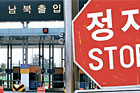
Passage to and from the Kaesong Industrial Complex was normalized on the 10th, less than 30 hours after its cessation; the cutting of the military communication line between North and South in protest at U.S.-South Korea joint military drills had led to transit problems for the Kaesong complex.
The North reported its revised position at 9:10 A.M. through the Kaesong Industrial Complex Management Committee; it would approve passage of Southern personnel and vehicles through the Military Demarcation Line (MDL) after all.
So, although the military communication line was supposedly cut off, office workers in the Kaesong Industrial Complex Management Committee, where the KT (Korea Telecom) communication line was hooked up, nevertheless connected the Korean Army and the North Korea People’s Army to approve passage for civilians through the MDL.
As a result, 80 South Korean workers who had been detained in the Kaesong Complex returned safely to the South on Wednesday and 250 South Korean persons were able to enter on the 10th.
There are diverse opinions on this sudden normalization of passage.
Some analyze that North Korea did not anticipate that its protest policy would backfire, because they failed to appreciate that the military communication line would link directly to the work of the Kaesong Complex.
Although North Korea has been raising tensions in the political and military spheres, heightening the possibility of a military collision with the South, it has generally guaranteed civilian exchanges and economic cooperation, especially for South Korean businesses in the Kaesong Complex.
North Korea has presumably been shocked by the unexpected damage to the Kaesong Complex caused by cutting the communication line.
If the Kaesong Complex stops running, a 30 million U.S. dollar meal ticket is thrown away. It is no small burden for North Korea to take care of an extra 30,000 workers and their families in times of inferior food security.
Professor of North Korean Studies at Korea University Yoo Ho Yul interprets it all thus, “It might have been an immature decision by the Northern military authorities, who did not keep the vulnerability of the Kaesong business in view. The North’s regime had not even considered a lockout of the Kaesong Complex, so it opened and permitted passage only in a day.”
There is another possibility, that by maximizing tension between the North and the South by suspending passage to the Kaesong Complex, North Korea was trying to drive the U.S. to sit at the negotiating table, but the reactions of South Korea and the U.S. were too strong, beyond their expectation. Therefore, the North took a step back.
Such actions are seen as conventional when speaking of North Korea, which is a place of absurdity.
President of the Sejong Institute Song Dae Sung said, “It is an unforeseeable act of a ridiculous country. We should not have joy and sorrow in quick succession just because we cannot predict what kind of cards the North plans to show us.”









