

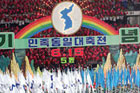
Two big non-governmental exchanges between North and South Korea are scheduled for this spring. The two countries’ labor organizations have agreed to hold a joint ceremony in Seoul for Labor Day on May 1, while the “Joint Committee for the Practice of the June 15 Joint Declaration” (henceforth, June 15 Joint Committee) is planning a ceremony for the 10th anniversary of the June 15 Joint Declaration.
The Chairmen of South and North Korea’s June 15 Joint Committees held a meeting on March 7 and 8 in which they decided to celebrate the 10th anniversary with a main conference, photo exhibition, art performances, regional events and the like.
Earlier, the General Federation of North Korean Trade Unions had agreed to hold a joint Labor Day reunification event in Seoul with representatives of the Federation of Korean Trade Unions and Korean Confederation of Trade Unions.
North Korea came out in favor of such cultural exchange in the 2010 New Year Joint Editorial, declaring, “Cooperative projects should proceed through association and contact in each class. Free discussions on unification and activities should be guaranteed among a wide range of people.”
In the past, however, North Korean labor organizations and the June 15 Joint Committee have been used to reflect the position of the North Korean authorities, and doubtless North Korea’s demands for peace and adherence to the two inter-Korean declarations will become fiercer around this time. In tandem, pro-North Korea organizations in South Korea will doubtless demand changes to South Korea’s policy as well.
The South Korean branch of the June 15 Joint Committee is planning a grand 10th anniversary ceremony. During a regular conference between Committee heads on February 4, Chairman Kim Sang Geun stated, “Thanks to the broad participation of each political party, organization and individuals, the 10th Anniversary of the June 15 Joint Declaration will be a national ceremony.”
Specifics such as schedule and location of the June 15 Joint Ceremony have not been agreed yet. However, given the expense of the event and its intended effect, the likelihood is that it will be in South Korea. The usual characteristics of the annual ceremony emphasize “Uriminzokkiri,” North Korea’s favored notion of inter-Korean relations to the exclusion of other parties, so the suspicion is that it will be a forum for denouncing the South Korean government’s North Korea policy.
Some analysts suspect that North Korea and pro-Pyongyang leftists in South Korea are hoping to kick-start an anti-Lee Myung Bak movement, and that they are planning to use the events to influence the chances of President Lee Myung Bak’s ruling Grand National Party in local elections on June 2.
Kim Young Soo of Sogang University in Seoul partially agrees. “Through a successful joint-event,” he says, “North Korea and pro-North Korea factions in South Korea are hoping to try and show off the legitimacy of their policies on South Korea and to be accepted by the public, in the hope of having a relationship with South Korea like it was during the Kim Dae Jung-Roh Moo Hyun administrations.”
Professor Kim commented that, “North Korea is aware of the fact that the South Korean government won’t approve the joint ceremony willingly. The North Korean calculation is that the ceremonial events could place the responsibility for the stagnant Inter-Korean relationship on the Lee Myung Bak administration, putting additional pressure on the South Korean government.”
The South Korean government is hedging its bets for the time being. Lee Jong Ju, a spokesman for the Ministry of Unification, stated in a March 10 press briefing, “Several additional working-level meetings are required. The plan is to decide the government’s position after observing the progress at these working-level conferences.”
Needless to say, progress on North Korean issues such as the continuation of the Six-Party Talks or changes to North Korea’s attitude on current inter-Korean sticking points like Mt. Geumgang and Kaesong City tours or Kaesong Industrial Complex management could all influence the South Korean government’s position on the joint ceremony.









