

Increasing market activity in North Korea is raising the bar
when it comes to competition between vendors to sell goods. This is fueling an
emerging trend amongst the donju (newly affluent middle class), who are paying
high prices in exchange for specialized equipment and know-how concerning food
manufacturing and services, Daily NK has learned.
“Food purveyors (mostly donju) these days are realizing that
greater profits can be made by becoming direct producers,” a source from South
Pyongan Province told Daily NK in a telephone conversation. “Because of this,
they’re seeking out individual producers and asking them to sell their
equipment for however much it costs.”
Additional sources in the same province and North Pyongan Province corroborated this news.
Birthday cake, chocolate, and biscuit producers can sell
their production know-how to donju for 500 USD, the source said, noting, “They
refrain from selling it to donju in the same area though, as that would have
negative repercussions for their own competitiveness in the market.”
This new trend highlights the rising consumer culture that
has emerged under the Kim Jong Un regime, with relaxing restrictions allowing
for increased vendor and marketplace activity.
Growing competition is emerging between the ‘old’ donju, who
bring in goods from China, and the ‘new’ donju, who focus on creating goods
within the country. Competition has been ignited by the fact that only a
limited quantity of imports can cross the borders, while local production is
determined mostly by the producers’ capacity to manufacture.
This is why some donju are traveling to food manufacturing
sites in China or Pyongyang to learn manufacturing methods in exchange for
cash.
The trend is not limited to the area of food production.
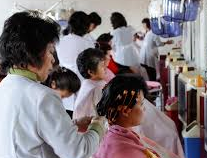
“More donju in provincial areas are trying to learn skills from Pyongyang’s
Changkwangwon hair salon,” the source reported. “The idea is to learn it
hands-on and then go to other regions to set up their own salons.”
Against this backdrop, donju are purchasing foreign hair
salon kits (selling for a minimum of 500 USD) that are difficult to get into
the country. The state-run Changkwangwon uses such opportunities to earn
foreign currency, becoming another beneficiary of the marketization movement.
The birthday cake market requires even more hands-on
experience. “Because it’s not easy to produce cakes, even though some people
get everything on paper, they often fail. This is why in many cases a worker is
sent directly to the site of manufacturing, paying roughly 100 USD (800,000
KPW) each day for training,” she explained.
The secrecy surrounding some industries has encouraged those
without proper means to cheat the system. “Some vendors who don’t have a lot of
funds poach workers who were hired at specific production facilities by
offering higher wages, and that is how they acquire knowledge of the production
techniques,” she added.
Such trends signal that along with greater marketization and
competition, people are increasingly turning to more creative ways, both good and
bad, to get a stronger foothold in the market. Without a comprehensive
regulatory framework or stronger institutions in society, it appears “the law
of the jungle” will continue to prevail, the source concluded.









