

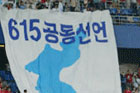
In the 2009 New Year’s Common Editorial, North Korea once again demanded that the Lee Myung Bak administration implement the June 15 Joint Declaration and the October 4 Inter-Korean Summit Agreement, labeling the Southern administration a “fascist dictatorship” and a “conservative betrayal.”
The Editorial also gasped, “The national unification movement, which had actively advanced, faces a serious challenge from the South Chosun conservative grasp. We will not allow any elements to try to derail our historic North-South Joint Declaration.”
It was confirmed in the editorial that the North’s intention to implement the two declarations regarding policy towards South Korea has not changed from last year; “We have to activate the national unification movement under the slogan, ‘Let’s step up independence and unification, raising high the flag of the June 15 Joint Statement and the October 4 Agreement.’”
Last year, North Korea avoided using direct expressions about the Southern administration in its common editorials due to the expectation that the two declarations would be implemented.
However, in this year’s editorial, North Korea criticized the Southern administration as a fascist dictatorship” and a “conservative betrayal,” and decried “the crazy South Chosun ruling factions’ indiscreet maneuvers for conflict between the North and the South.”
Since the first Inter-Korean Summit of 2000, there had not been any direct criticisms against the South Korean administration in the annual editorial, so this editorial reflects Kim’s intent to compete with the Lee administration.
It is certainly hard to imagine any advancement in inter-Korean relations, as North Korea shows its will to continue to hold to a hard-line, claiming “the Lee Myung Bak administration’s responsibility” for the freeze in its editorial.
The Lee administration has the intention to “set up a new framework” for inter-Korean relations, sticking to its principles in the long term, so the stalemate may continue for a while.
President Lee revealed on December 31 that, “We will solve the North Korean problem from a distant perspective. We need the attitude of building stoutly inter-Korean relations in a proper way from the start, even though it is difficult.”
North Korea has instigated South Korean people to go on anti-government struggles in its common editorial, while emphasizing “Uriminzokkiri” (being ‘amongst our nation’).
It has suggested specific ways of struggling, stating that, “South Korean people should strengthen the will to struggle to remove the possibility of war and to overthrow the conservatives’ fascist reign by raising the slogans of independence, democracy and unification.”
“The People’s Army takes a decisive position against those who try to harm our independence, dignity, and the socialist system,” the editorial stated. It implied that North Korea may assume firm measures against the South Korean administration’s suggestions of North Korean human rights abuse and Southern NGOs’ scattering anti-regime leaflets in North Korea.
That being said, a lack of direct criticism of President Lee Myung Bak and any other notable claims while only stressing the need for implementation of the two declarations can refer to the fact that North Korea does not want to deteriorate inter-Korean relations any further.
Professor of North Korean Studies at Korea University Yoo Ho Yul noted that, and further, “There was no hint of improvised confrontation with the Lee administration, so it left some places for negotiation with the South.”









