

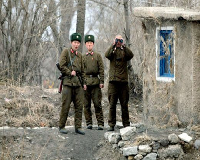
On the heels of the recent nuclear test, North
Korea has handed down a new string of mandates to tighten illegal river
crossings on the Sino-North Korean border and stamp out illicit cross-border
phone calls, further hindering movements and communication in already dire
conditions.
“The political tensions from the state’s
recent hydrogen bomb test has led to an order from the Party’s Central
Committee calling for the complete seal-off of illegal river crossings and
phone calls on the border,” a source from North Hamgyong Province told Daily NK
in a telephone conversation on January 11. “In relation to this, officials from the
provincial State Security Department [SSD] branches , Ministry of People’s Security [MPS, North Korea’s equivalent of a police force], and border patrol
forces have put together a joint operation to control borders and cut off phone
conversations with people in China.”
Daily NK spoke with sources in Jagang, North
Pyongan, and Yanggang Provinces who all confirmed the same developments in
their respective regions.
He said that surveillance picked up at the end
of last year after personnel from the provincial, city, and county SSD and MPS units were
dispatched to North Hamgyong and other border areas. Streets and villages were and continue to be teeming with agents from both security organs from early in the morning to late
in the evening, obsessively monitoring and questioning people moving in and out
the area. Strip searches invariably follow aggressive lines of questioning, according to the source.
“In border counties like Onsong and Musan,
they’ve increased the number of patrol guard posts made up of factory workers,
farmers and Worker-Peasant Red Guards [North Korea’s largest civil defense
force],” he said. “Once it starts getting darker, movement outside is
restricted, and you can also be dragged away to the local MPS unit and
interrogated. The focus is not only on who you are; they probe you on every last little detail about everything”
On the borders, a
‘three-front patrol’ system has also sprung up to the same end. The first line is manned by border patrol and a
stakeout post, the second line has MPS personnel rotating in checking and
inspecting people, and the third has Worker-Peasant Red Guards from collective
farms and local factories on the watch by night.
“Inspections of train passengers traveling
across the border has become very strict, so it’s causing a lot of
inconvenience for people,” he asserted. “Especially around Komusan and
Huchang station that connect to Hoeryong, Musan county, and Rason city, they halt
the train for an hour and treat the passengers like criminals, using vulgar
language and digging through their pockets.”
What started as intermittent scrambling of
phone signals by security officials at the end of last year has culminated more
recently–that is, following the nuclear test–in “non-stop efforts”
making it “very difficult” to place calls outside of the country. In
fact, the source struggled to find a solid signal while speaking to Daily NK despite testing a number of locales. His call dropped over 35 times in the course of an hour while speaking with our reporter.
“Not so long ago, they only did this in areas
where people on their watchlist live. But now it’s a blanket approach, so the
signal is almost completely dead regardless of the area, he said, explaining that for now, gone are the days for those
in border areas to easily pick up a signal from across the border to place
external calls.
“It’s virtually impossible,” he asserted.
He added that the clampdown on
phone signals is aimed not only at keeping outside information from coming in and
vice versa but more specifically to thwart the efforts of potential escapees, who
typically first establish contact with others across the border and then wade
through the river bordering with China.
“Even on the Chinese side these days patrol has become stronger and there are more security personnel compared to before,”
he explained. “Even in countryside neighborhoods you’ll see Chinese patrol cars
moving back and forth frequently; border control agents also show up suddenly
with their dogs to inspect the area, which just makes it all the more fraught.”









