

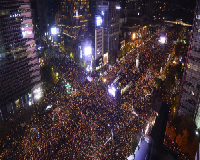
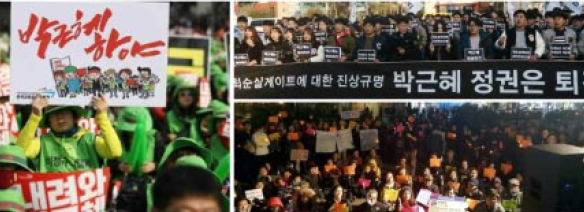
North Korean state media including the Rodong Sinmun and Korean Central Broadcasting Agency (KCNA) have been reporting on South Korea’s candlelight rally for President Park Geun Hye’s resignation on a daily basis. Propaganda is reportedly stating that South Korea will soon collapse and that citizens should be ready to “achieve the great goal of reunification.”
“In recent days, factories and schools have launched a propaganda campaign with slogans saying, ‘The South Korean government is corrupt,’ and, ‘The rotten (South Korean) regime will soon collapse.’ The authorities have held lectures for residents and soldiers on a daily basis to ‘prepare for the upcoming revolutionary event of reunification,” a source in South Pyongan Province told Daily NK on November 14.
In a lecture targeting military officers entitled, “A proactive approach to preparing for the national goal of reunification,” the story of the Suryong [Kim Il Sung] lamenting the two lost opportunities of reunification after the Korean War was emphasized, with the reiteration that this new chance must “not be squandered.”
The two opportunities for reunification mentioned in the lecture refer to the April 19 Revolution in 1960, and the June 10 Democratic Uprising of 1987, both of which occurred in South Korea. Although these events were grassroots democratic movements created by students and citizens as central forces against the dictatorial regimes (of South Korea), for propaganda purposes, the North Korean authorities emphasize only the confusion and nationwide paralysis of South Korean society at the time.
“The North Korean authorities seek to portray the national protest in South Korea as a launchpad for uprising and an avenue to reunification. It also seems intent on portraying North Korea as a problem-free nation and a bastion of justice,” the source added.
In parallel with coverage of the protests in Seoul through the media and lectures every day, North Korean residents are also showing great interest in the recent news. Individuals are reportedly exchanging opinions at the marketplace with buzzwords picked up from the coverage, such as ‘protest’, ‘democracy’, and ‘resignation of the President’, noted the source.
“North Koreans are receiving news on the current situation in South Korea through the Rodong Sinmun and TV each day. They remark about how the South is riddled with its own issues, noting the Choi Soon Sil incident,” a source in North Pyongan Province said, adding, “but the majority of people are surprised at the free and democratic mass protests taking place, asking, ‘How could that be possible?’ They are particularly in awe of the fact that South Koreans can choose to elect or impeach their leader (president) according to the will of the population.”
The news of more than a purported one million people protesting on the streets of Seoul is being admired by North Koreans in some ways, despite the regime’s intentions. “Some people are saying, ‘that [South Korea] is what real democratic society looks like, if it were for us [North Koreans], we would have been flattened by tanks like in the Songrim Incident* in the 1990s’,” he concluded.
*The Songrim Incident
During the period of widespread famine in the 1990s, executives of the Hwanghae Iron and Steel Works decided to sell a single shipment of steel plates produced at their factory to China in exchange for corn in order to feed their starving workers in 1998. The North Korean authorities responded by publicly executing the executives for selling the state-owned materials without permission. Hundreds of workers who gathered at the steel mill the next day to protest the executions were crushed with tanks.









