

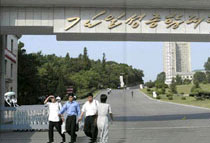
Central and provincial ministries that deal with college admissions have been inundated recently as competition heats up among female students hoping to enter one of North Korea’s performing arts colleges.
One inside source based out of Shinuiju told the DailyNK via a phone interview that “after the college entrance examinations last February and the impending announcement of the examination’s results, excessive fights among parents trying to send their children to performing arts colleges have created resentment among those who are barely getting by.”
“The People’s Committee College Recruitment Boards in each province or factional divisions and cadres of the provincial Party related to university student admissions, including college leadership departments, have said that they are afraid to pick up the phone due to the large volume of calls asking whether or not students have been admitted,” relayed the source. “The homes of the leaders in charge of admissions are besieged by those who come to offer bribes.”
The reason behind the sudden rise of performing arts colleges is related to the growing number of foreign-currency earning organizations being set up in foreign countries. University-trained dancers and servers staff these organizations.
“Enterprises set up to earn foreign-currency recruit female students who are over the age of 18 and who are graduates of performing arts colleges. As many as 10 ~17 students are selected each school year,” explained a source in charge of North Korean restaurants in Yanji, China.
The source added that among the graduates of performing arts schools, “many are selected as hotel staff or tour guides, so these schools are considered dream colleges in the North.”
In the 1970s, the arts were regarded highly as this was the time that Kim Jong Il was working oin projects such as the “Top 5 Revolutionary Operas” and “The Revolutionary Play,” However, after Kim Il Sung’s visit to Eastern Europe and the subsequent emphasis on national investment in education to foster prodigies, interest in the arts decreased significantly.
According to an inside source, in the past North Korean citizens often referred to performing arts colleges as “can colleges (for people who have nothing in their heads).” The source noted, during the March of the Tribulation, “as support for artists evaporated, schools had a difficult time attracting students.”
“Recently however, with the resurgence in popularity of performing arts colleges, the stigma of ‘can colleges’ has been shed and the new name ‘Choenbul College’ has stuck. (Editor’s note: cheonbul is derived from the Sino-Korean words meaning “one thousand” dollars.) The reason why this name has stuck is that without 1,000 dollars, it is difficult to even approach their front gates,” the source explained.
In the midst of the rising interest in performing arts colleges, a simultaneous increase in interest in foreign languages has been taking place.
Another source added: “When the foreign currency earning organizations select personnel, speaking English or Chinese is a beneficial qualification which can set apart a candidate from the other applicants. Performing arts students receive private lessons by seeking out high school teachers or college professors or do self-study in order to learn English or Chinese.”
Simultaneously, the trend of plastic surgery among female students has been on the rise.
Such emphasis on outward appearances is not all that surprising, considering performing arts students must perform in front of an audience. “Even recently, when employing people at foreign restaurants, hotels, and as tourist guides, appearance is looked at first, so students pay extra attention to the maintenance of their faces and figures,” noted a source.
“There is a saying that households with daughters who go to an average college struggle for 10 years while those who have daughters attending performing arts colleges are ruined for three generations. No matter how wealthy or powerful the household is, looking after a daughter who attends a performing arts college is not easy.”
It has been said that female students who attend performing arts colleges turn their noses down at the sign of Chinese-made cosmetics. These students prefer using cosmetics made in France, India, and South Korea.
“A South Korean massage cream, which costs 12,000 North Korean won, cannot be sold at performing arts colleges due to shortages. Among the households of the leaders, orders for South Korean cosmetic sets are placed through people who frequent China or work in customs.”









