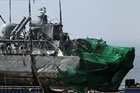
The cause of the Cheonan disaster will be a major factor in whether or not a 3rd inter-Korean summit comes to pass.
Indeed, inter-Korean relations experts see the possibility of inter-Korean summit talks taking place before the cause of the sinking has been found as extremely thin.
At a debate forum, ‘3rd Inter-Korea Summit Talks: historical lesson and direction,’ hosted by the Sejong Insitute on April 15th, Lee Sang Hyun, Director of the Security Studies Program at the Institute, explained, “The probability of inter-Korean summit talks taking place is getting thinner due to the troubled domestic circumstances caused by the sinking of the Cheonan. If the rumor of North Korean involvement in the incident is proven to be true, an inter-Korean summit will be impossible until countermeasures have been set up.”
Kim Byung Ro, a professor at Seoul National University, agreed, adding, “Inter-Korean summit talks will be critically affected by the results of the investigation into the Cheonan sinking of March 26th. We have to decide the timing of any inter-Korean summit with reference to public opinion on North Korea.”
Therefore, participants unanimously agreed that for a successful 3rd summit, “General agreement and the formation of a social consensus are required on the period, location, and especially the agenda of the summit.”
Hosting it in Seoul was agreed to be acceptable, however, Kaesong, Mt. Geumgang and a third country were all put forward as other possible options.
Meanwhile, Lee argued that even if the sinking of the Cheonan was found to have been caused by North Korea, military retaliation would be impossible.
“We did not react immediately after the occurrence of the North Korean provocation, so the incident has passed the state of an ‘existing urgent threat’ which is a prerequisite for the general right to self-defense… This condition means that there would be technical difficulties if we tried to retaliate.”
He cited the sinking of a South Korean vessel (PCEC 56) by North Korean coastal artillery near the Northern Limit Line (NLL) in the East Sea on January 19th, 1967 as an example.
At the time, 39 crew members were killed in the sinking of the Dangpo, and South Korea’s then President Park Chung Hee subsequently argued for retaliatory military action against North Korea. However, the United States restrained South Korea from taking independent action and, as a result, no measures were taken.
Also, in the cases of the so-called Axe Murder Incident in August, 1976 at Panmunjom, the Aung San terrorist attack in Myanmar in October, 1983 and the KAL bombing of 1987, no tougher stance was taken and the United States closed the cases after officially designating North Korea a state sponsor of terrorism.
Therefore, Lee emphasized, “Even if the incident is North Korea’s responsibility, there are not many practical measures possible. Unless North Korea attempts to create a new threat or local provocations occur along the DMZ, South Korea cannot punish North Korea with military force.”