

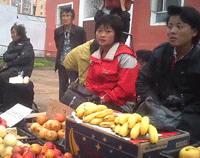
Amid daily propaganda proclaiming the purported success of hydrogen bomb test in North Korea, its citizenry
continues to display little interest in the subject, choosing to devote its attention to doing as much business as possible at the markets.
On the 17th, Daily NK spoke with a
source in North Pyongan Province, who told us that nine out of ten citizens,
when questioned about their opinion of the latest nuclear test, said “they
don’t care.”
“Although the remaining one citizen out of this survey went against
the current, citing state propaganda about the nation’s status as a powerful military state, the
majority of people express zero interest in the subject, wondering instead why
the regime is not taking steps to improve the daily lives of the people,” she reported.
Daily NK spoke with additional sources in
both South Pyongan Province and North Hamgyong Province who confirmed that
these findings closely reflected sentiments in their respective regions.
With all of the attention around the New
Year’s Address and Kim Jong Un’s birthday celebrations, coupled with state media trumpeting
the success of the nuclear test at every turn, citizens are “quite sick of it all,” the source
added, explaining that amid all the strained jubilation “all anyone really has on their mind is how to do better in the markets.”
And stabilizing market prices suggest that
they have indeed done everything in their power to work around these events, squeezing as much economic activity as possible into daily life despite all the background noise. Facilitating this processes is the fact that, following the nuclear test, there have been
no crackdowns on market activities and trade with China “continues mostly
uninterrupted,” she asserted.
Some nervous members of the new affluent middle class [donju], concerned about potentially negative effects on import and export prices wrought by the latest nuclear test, frantically contacted their trading partners in China in an effort to ascertain the degree of the potential fallout. To their surprise, however, their concerns were quickly assuaged by their Chinese counterparts, who reminded them that as the sanctions imposed on North Korea following the first three tests failed to deliver the desired blow, little attention is being paid this time around as well.
Moreover, after the crackdown on limits on the amount
of rice that could be sold at the end of last year ended, the price of rice
finally fell and people’s livelihoods began to stabilize again, eliciting sighs
of relief for most. At the time of writing, rice was trading for 5019 KPW per
kilo in Pyongyang, 4970 KPW per kilo in Sinuiju, and 4980 KPW per kilo in
Hyesan, a drop of about 300-500 KPW from last month.
The RMB-KPW exchange rate has also dropped slightly. As the Lunar New Year holiday (February 8) fast approaches, North Koreans are anticipating an influx of RMB to pour into the country via the Hwagyo community (overseas Chinese residents). Consequently,
the RMB exchange rate has dropped slightly from 1320 KPW to 1290 KPW.
The takeway from these trends is a cognizance among the majority of the population that “nuclear tests will not fill their bellies.” Although
Party cadres have little choice but to carry on with their daily propaganda,
stating, “We have become a powerful nation that the rest of the world fears,”
the number of people who buy into this narrative remain in the minority, the
source concluded.









