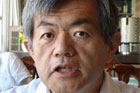
[imText1]I started learning Korean in 1977 during my second year of university. While learning Korean, I became interested about the Korean Peninsula and for the past 30 years I have been studying this subject.
Since 1996, I have been working in the research department for a Japanese NGO, Korea Today and as the truth about Yokota Megumi was revealed through a paper published by the monthly Korea Today I became greatly interested on this topic. This is when I began a movement to help people affected by abductions.
In truth, at the time, Japanese people were not very enthusiastic about helping victims of abductees. Though I had heard of a number of abductees cases, even I had not fathomed of beginning a movement. It has not even been 10 years since the Japanese change attitudes and decided to make an effort to fundamentally resolve the abductees issue.
The only thing I can confidently say is that the various cases including the nuclear issue and KAL bombing incited anti-North Korea feelings amongst the Japanese people. From a Korean perspective, Japan could at any time develop a hard-line policy against North Korea. However, in this case, the more exact translation would be that these antagonistic feelings burst.
Japan must implement fundamental change through the Yokota Megumi case
The abduction of a middle school student Yokota Megumi by North Korean agents marked a critical change in the Japanese government’s attitude towards North Korea. This story published in the “Korea Today” was aired on Asahi Broadcasting by producer Ishidaka Genzi in October 1996.
The following year February, Minister Nishimura Shingo questioned the Japanese Prime Minister regarding the abduction of Megumi in a public discussion. At the time, Prime Minister Hashimoto Ryutaro responded with an answer to alarm the Japanese public, “We are conducting investigations with the possibility of including abductees cases.” Then in March 25th that year, the ‘Association of Families of Victims Kidnapped by North Korea (AFVKN)’ formed. Until then, there had been no communication between family members.
Asahi Broadcasting is a company affiliated with Asahi Newspaper with strong leftwing influences, while Sankei has more rightwing. Members of each party, Asahi and Sankei made efforts to form the AFVKN, becoming a major issue in Japan. Nonetheless, these groups cooperated well as each knew the seriousness of the issue and had already been dealing with the issue individually.
As the AFVKN was formed, more and more people became interested in helping families of abductees victims and more NGO’s began to form. An organization was formed in the district where Yokota Megumi was abducted, Nigata, then Osaka and surrounding areas and Tokyo.
These movements were all proactive and eventually led to the formation of the “National Association for the Rescue of Victims Kidnapped by North Korea.” I worked at the rescue office in Tokyo which oversees national operations and in 2000 was officially appointed the First Secretary General for the National Council.
Both leftists and rightists participating proactively in the Japanese rescue abductees movement
When the rescue movement for abductees began, there was a significant number of former pro-North Korea activists and ex-members the Communist party also. The current President of the National Council Sato Kazumi and Kozima Harunori who first began the movement in Nigata, are former members of the Communist party.
These are the people who helped the movement of repatriating Korean-Japanese in the 1950’s~1960’s.
I am not conservative but a social democrat. Rather than being conservative, we have strongly opposed communism and hence have been against Kim Il Sung and Kim Jong Il’s regime from the start.
However, there have been many complications amongst former pro-North Korea (pro-Kim Il Sung and Kom Jong Il) activists who later participated in rescue movements or joined movements for North Korean democracy.
From an objective stance, if these people had a sincere heart for North Korea, then it is possible that remnants of these influences remain. The contradiction is clearly visible simply by observing the North Korean regime.
Even if time moves on, the people who are undeniably pro-North Korea are the people to support the dictatorial regime and human rights violence or have individual interests in North Korea.
Japanese people awake to the North Korean dictatorship through abductees rescue movements
The rescue movement began with a petition for government involvement and action. The petition read, let’s “resolve the issue of North Korean abductions of Japanese nationals.” At the first national conference in 1999, families of Japanese abductees realized that there had been more Korean victims of abductions.
We recognized that the rescue movement needed to include abducted Koreans and so adjusted the petition to read, let’s “resolve the issue of North Korean abductions of all people.”
We added accounts of Korean abductions and this is when many participants of the rescue movements and Japanese citizens in general, came to learn of North Korea’s issues, Kim Il Sung and Kim Jong Il’s dictatorship.
The root of 60 years of North Korea’s problems including abductions, political prison camps, starvation, nuclear problems and defectors stems from North Korea’s dictatorship. These problems can only be resolved with change to the regime.
Now, there is a greater number of people from both current government and opposition who argue “All issues can be resolved with the collapse of the Kim Jong Il regime,” though it was a notion unfathomable 10 years ago. That’s how important the issue of abductees has affected all of Japan, similar to ‘study effectiveness.’
If a Japanese person went to Korea during the generation of the Cold War, people would say, “Japanese people have poor knowledge of security.” Now, the tables have turned completely.
The issue of North Korean human rights is directly associated to victims of abductions and North Korean-Japanese families. Therefore, regardless how much South Korea ignores the issues of abductees, defectors, prisoners of war and North Korea human rights, Japan will ultimately not overlook the North Korean dictatorship.
As Japan is a democratic state, undoubtedly there will be different opinions to this viewpoint. Nonetheless, we will not compromise our Japanese comrades who were abducted, nor the thousands of innocent children dying of starvation and made to die in the cold by the North Korean regime.