

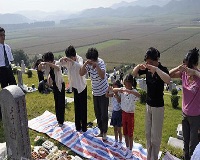
Many North Korean citizens will visit ancestral burial sites
tomorrow as the country marks the Cheongmyeong Day public holiday. Rumor has
it that a year of good luck will find those whose ancestors are well cared for,
and in superstitious contemporary North Korea few such opportunities are ignored.
The day was not a public holiday until 2010. However, a lot
of people used to visit their family burial sites on the 105th day after
the Winter Solstice, or Hansik. In
2012 this practice was halted, and people were pushed to do the same on Cheongmyeong
Day instead. The explanation for the official shift toward Cheongmyeong Day is,
defectors assert, that the concept of Hansik
is a foreign [Chinese] one. Official 2014 North Korean calendars, which are
published by state publishing houses in Pyongyang and distributed/sold at home
and abroad, show Cheongmyeong Day in red.
One defector, who recently arrived in South Korea from South
Hwanghae Province, told Daily NK, “There is this idea that your fortunes will
improve if you seek out the tombs of your ancestors and appeal to them for
help, and so many people go annually. When we went, the children ate themselves
silly while the adults ardently appealed to their ancestors for good fortune.”
“Things are unstable, so this culture of appealing to the
dead to improve your fortunes has been spreading for some years. Even if your
average daily meal is just noodle porridge, this day you show sincerity with
white rice and meat. We prepare jesa
food [food used in ceremonies to show respect to ancestors], which is what the
children like the most.”
During the era when the state Public Distribution System (PDS)
was still functional, there were few superstitious customs in North Korea, but twenty
years of severe hardship have seen a culture of superstition take root at all
levels of society.









