

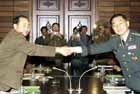
The year 2008 was for a tie in the “tug of war” between the Lee Myung Bak administration, which tried to set up a new framework for policy on North Korea and Kim Jong Il, who tried to subdue that change.
◆ The Lee Myung Bak administration’s attempt to set up a new framework
Taking a critical view of the previous ten years that could not possibly have led to North Korea changing; the Lee Myung Bak administration established a new policy based on reciprocity. North Korea strongly opposed this South Korean policy, so inter-Korean relations naturally degenerated.
The Lee administration’s slogan, “coexistence and mutual prosperity,” was quite different to that of the Roh Moo Hyun administration, “peace and prosperity,” advocating the logic of the Sunshine Policy.
The Lee administration emphasized that North Korean problems should be solved through “international mutual-assistance,” deviating from the “national assistance structure” or from the slogan, “Uriminzokkiri’ (‘amongst our nation’).” Accordingly, it pledged itself to pursue inter-Korean economic cooperation depending upon steps towards North Korean denuclearization (“Vision 3000: Denuclearization and Openness”) and to provide humanitarian aid consistently, with a concomitant request for the repatriation of South Korean POWs and abductees.
President Lee has expressed his concerns about North Korean defectors hiding in China or other countries and the administration played the role of cosponsor on the annual U.N. resolution on North Korean human rights.
Professor of North Korean Studies at Korea University Yoo Ho Yul said that, “The Lee administration has kept the principles of the policy towards the North, actively promoting the human rights issue, generating international effort for the nuclear negotiations, providing humanitarian aid and participating in economic cooperation.” Regarding the frozen relations with the North, he suggested, “It is not a crisis but a good opportunity.”
◆ North Korea’s attempt to subdue South Korea
North Korea has been giving the cold shoulder to the Lee administration.
North Korea, which used to observe the strategy of trying to tame the South Korean administration whenever a new one was launched, has sternly criticized the Lee administration’s policy.
Actions followed. On the day after March 27, when President Lee emphasized the Inter-Korean Basic Agreement in 1991, not mentioning the June 15 Joint Declaration or the October 4 Inter-Korean Summit Agreement in the working meeting of the Ministry of Unification, North Korea started taking a hard-line, evacuating South Korean staff from the offices of the North-South Economic Cooperation Administration.
Additionally, North Korea announced the suspension of dialogue among inter-Korean authorities. They claimed to take serious issue with comments by the Minister of Unification Kim Ha Joong and Commander of the Joint Chiefs of Staff Kim Tae Young about the possibility of a South Korean preemptive strike on North Korea, but the real problem was that there was no South Korean intent to implement the two declarations signed by the North’s highest leader, Kim Jong Il.
Though potentially a problem, researcher at the Korea Institute for National Unification (KINU) Park Young Ho simply believes that, “North Korea only compelled the South to implement the June 15 North-South Joint Declaration and the October 4 Agreement in the way the North liked.”
Researcher at the Institute for National Security Strategy Kim Hwan Suk assessed that, “North Korea has press the South Korean administration this year, via the followers of the Sunshine Policy and the enterprises in the Kaesong Complex. At the same time, it has provoked ideological conflict in South Korean society by stressing the slogan of ‘Uriminzokkiri.’”
◆ From the shooting incident on Mt. Geumgang to the December 1st Measure
In the first half of this year, the boring battle of nerves between the North and the South continued. On July 11, the shooting of a tourist at Mt. Geumgang called Park Wang Ja accelerated the deterioration of inter-Korean relations.
The South Korean authorities requested that the North suspend the tours immediately and examine the site of the incident, but the North did not allow it, insisting that the incident was the Southern tourist’s fault.
After that, inter-Korean relations were on thin ice, with rumors of Kim Jong Il’s faltering health spreading; the ongoing scattering of anti-Kim leaflets in North Korea by South Korean NGOs, and South Korea’s co-sponsoring of the U.N. resolution on North Korean human rights. North Korea eventually took the December 1st Measure, which was to implement a suspension of passage through the Kyungui Line and Kaesong Tours, closing the office of the North-South Economic Cooperation Administration, cutting numbers of residing South Korean employees in and restraining overland passage into and out of the Kaesong Complex.
Meanwhile, there were two military working group meetings, but the North just threatened the South over the leaflets issue. Moreover, after mid-August, when Kim Jong Il’s health problems were released, North Korea increased defamation broadcasts against South Korea dramatically.
◆ Can the two Koreas make a breakthrough?
The incumbent administration will not do a 180 in its policy on North Korea. Therefore, experts on North Korea predict that the relations are unlikely to be normalized in near future.
Professor Yoo predicted that, “A breakthrough could occur after the U.S. policy towards North Korea appears, in itself after the Obama administration takes office.”
President Lee’s comment, “If the installation of a new framework for North-South relations is impossible in the long run, sometimes waiting is a different kind of strategy,” is significant. As long as the Lee administration keeps the principles of its North Korea policy, then the superficial results of inter-Korean relations in 2008 cannot be evaluated as regression.
KINU researcher Park said, “This year will be noted as a period for tweaking relations with the North in order for normalization later on.”
Notably, although the exchanges between the two authorities were deadlocked this year, exchanges and cooperation in civilian fields steadily developed. Passage between the North and the South increased in November by 24.8 percent and trade by 3.7 percent, amounting to 1.7 billion dollars.
Institute for National Security Strategy researcher Kim emphasized that “For the time being, it seems difficult to find an interface between the North and the South, but the South should wait for changes in the North Korean attitude while sticking to their principles.”









