

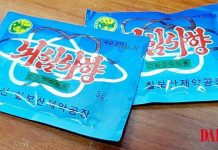

North Korean health
supplements available in China have been found to contain harmful levels
of heavy metals and reportedly remain in circulation.
A source
in China close to North Korean affairs sent a video of such products
available in Yanji to Daily NK on March 7. Hundreds of packages of
products labeled “Chosun Gomyol” (“North Korean Bear Gall Bladder”),
“Noishim Sahyang” (“Brain Musk,” referring to the Musk Deer) and
“Angunguhwanghwan” can be seen in the video.
These products are
primarily sold in North Korean state-run restaurants abroad as well as
on websites in China catering to the ethnic Korean population there,
reported the source.
Instead of providing health benefits,
however, the products have been found to contain extremely high levels
of harmful heavy metals which can lead to serious health issues.
The
“North Korean Bear Gall Bladder” product advertises health benefits
including “rejuvenation” of the liver. But according to tests conducted
in 2016 by the South Korean government-affiliated National Forensics
Service (NFS), the product contains no traces of ursodiol and has been
made using gall bladder from pigs.
The NFS conducted tests on a
variety of other North Korean ‘health products’ as well. Tests on the
“Angunguhwanghwan” product found mercury levels 20,000 times higher than
the acceptable standard, arsenic 12,000 times the standard, and almost
four times the acceptable concentration of lead.
“Noishim
Sahyang,” which purports to help with a variety of symptoms, contained
49 times the standard level of mercury, three times the standard level
of arsenic, and five times the standard level of lead. Additionally, it
was found that the product was not made from the Siberian Musk Deer,
despite being named after the animal.
A product called “Uhwang
Chongshimhwan” (not pictured in the video), a marble-sized golden pill
of sorts purported to contain various natural ingredients, was found by
the NFS to contain 30,000 times the acceptable level of mercury and
1,600 times the acceptable level of arsenic.
Health products such
as these from North Korea are manufactured by companies affiliated with
the Reconnaissance General Bureau (RGB), Ministry of State Security,
and the military, and are a component of foreign currency-earning
ventures for the central government. One of the primary targets for
these products are South Korean tourists visiting North Korean state-run
restaurants in China, Mongolia, and Southeast Asia.
“Chinese
people typically stay away from these items now, knowing that they are
mostly fake,” the source in China said. “Instead, it’s mainly the
foreign tourists that are buying them.”
A defector originally
from Hyesan told Daily NK that “there are not many of these kinds of
‘premium’ traditional medicines available inside North Korea, and a lot
of the ones sold in the jangmadang (markets) are fakes made from pig or
dog parts.”
“There aren’t any health standards for these items in
North Korea, meaning the ingredients used in them are often unknown,”
she added, speaking on condition of anonymity.
“North Koreans these days avoid them due to the prevalence of fakes being common knowledge.”









