

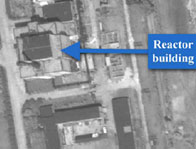
Contrary to a number of international media reports, satellite imagery dated May 26th, 2009, the day after the second North Korean nuclear test, does not appear to show any evidence that the nuclear reprocessing plant at Yongbyon is operating.
Yonhap, a South Korean news agency, and the Chosun Ilbo, a mass-market daily in the South carried reports Wednesday stating that U.S. spy satellites had observed steam being emitted by the plant, a sign that it had been restarted, which is something Pyongyang has threatened to do.
The reports were then reported and reprinted by a number of TV networks and newspapers
However, the Institute for Science and International Security (ISIS) released satellite imagery on Wednesday which shows no steam being emitted by the reprocessing facility itself or the coal-fired steam generation plant that serves it.
The ISIS report also notes that there are “no signs” that the cooling tower at Yongbyon is being rebuilt. If North Korea wanted to restart the reactor at Yongbyon it would be essential to rebuild the tower or construct an alternative cooling system, unless Pyongyang were “willing to settle for very low reactor power levels (and low plutonium production rates),” according to a May 12th Bulletin of the Atomic Scientists report by Siegfried Hecker, former director of Los Alamos National Laboratory and three-time visitor to Yongbyon.
Interestingly, however, after North Korea destroyed the cooling tower at Yongbyon in June of last year as a gesture of denuclearization goodwill, President of Committee for Democratization of North Korea Hwang Jang Yop revealed, “In 1996, I heard from the Secretary of the Munitions Industry Ministry that we had already produced enough plutonium for future nuclear weapons in the Yongbyon reactor, because these were nuclear weapons based on plutonium, but now we don’t need plutonium anymore because we have started producing nuclear weapons with uranium-235.”
If that were true, the Yongbyon facility would not have to be operational for North Korea to be capable of building further nuclear weapons, since Yongbyon is a facility for producing plutonium. However, to create uranium-235 requires centrifuges that separate uranium-235 from uranium-238, making highly enriched uranium (HEU), and the evidence that North Korea has this technology is limited to traces of HEU found on items given to the U.S. as part of the disablement deal in 2007. Based on the available evidence, according to Seigfried Hecker, “it is highly likely that North Korea has a uranium enrichment research effort but not at an industrial scale.”
Meanwhile, reports are beginning to indicate that the yield from the latest nuclear test may be below the 4-8KT range that has been reported internationally and far below the 20KT that was initially suggested by sources in Russia on the day of the test. According to Arms Control Wonk, a respected blog on the subject, the yield could be as low as 1.6KT, depending on the type of rock at the test site, while Bulletin of the Atomic Scientists suggests the yield was “4 kilotons or smaller.”
[imText1]
[imText2]







