

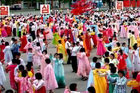
Kim Il Sung, in a decree dated July 27th, 1953 (Order No. 470 of the Chosun People’s Army’s Supreme Commander), claimed, “The war to liberate the Fatherland with the devotion of the Chosun People who opposed the American military invaders and the Rhee Syngman gang of puppets has resulted in our victory.”
Subsequently, North Korea designated the day when the Korean War armistice was signed (July 27th) as the “Day of Victory in the Fatherland Liberation War,” or “Victory Day,” and has counted it as one of ten national holidays ever since.
The reason why the North has always promoted the Korean War as a victorious one is primarily because Kim Il Sung made the preemptive strike, and the responsibility for the subsequent failure to spread Communism across the Korean Peninsula would fall directly on him if North Korea were to concede defeat.
On the other hand, if he could be said to have “successfully resisted an American attack,” then the War could be remembered as one in which the North achieved some kind of victory.
The most important focus, then, is to praise Kim Il Sung’s victorious achievement, and the North has three methods by which to do so.
The first is to say that, to the extent that the Korean War itself succeeded in safeguarding the Fatherland from an attack instigated by “American imperialists and South Korean gang of puppets,” the North fought a “victorious war.”
In Volume 12 of “Kim Il Sung’s Complete Works,” which has a higher degree of regulatory power in North Korean society than the Constitutional Law, the Korean War is recorded as a war in which the North was invaded first.
At the time of the outbreak of the War in 1950, the speech, “Let Us Drive out the Military Invaders with a Decisive Defense,” which Kim Il Sung gave at an Emergency Cabinet Meeting, contains a strong censure against the “South Korean attack.”
The address mentions the following: “The traitorous rebel Rhee Syngman’s gang of puppets initiated a sudden military invasion, opposing the North across the 38th parallel… under direct American control, the gang of puppets has been carrying out preparations to infiltrate the North for a long time… The Republic (the North) government has made its best effort to achieve peaceful reunification of the Fatherland, by preventing the dog-eat-dog fighting… Our People’s Army must clear out the military infiltrators by immediately frustrating the invasion of the enemies and mounting a decisive defense…”
The second piece of applicable logic is to suggest that even though North Korea was a new country, established less than a year before the war, it fought against enemy powers which were superior in number in order to defend itself, and therefore it was a “victorious battle.”
North Korea maintains that South Korea, after suffering as a colony subjugated to Japanese imperialism for 36 years, was able to enjoy happiness under Kim Il Sung’s leadership for approximately five years after liberation.
Through such experiences, according to the North, the South Korean people were able to recognize the value of the Fatherland, and were able to follow Kim’s leadership, and he helped them to gain their independence in the immortal anti-Japanese struggle. The North also claims that under Kim Il Sung’s leadership they able to fight and gain dominance over the American and South Korean forces.
Third and finally, North Korea maintains that thanks to the Korean War, it was able to humiliate the U.S., which takes pride in its long history of victory in war. This humiliation was in itself a victory for the North.
At this time, it had only been three years since the founding of the People’s Army, but Kim Il Sung’s unsurpassed leadership and strategic maneuvers, which helped to overcome Japanese imperialism, as well as the North Korean soldiers and civilians who came together in their devotion to Kim Il Sung, were able to defeat the combined force of 16 countries under the UN flag to protect the Fatherland.
In particular, the North Korean authorities boast that the U.S., which placed unwarranted confidence in its numerical and material superiority in invading the North, eventually came to sign the Armistice Agreement holding a white flag.
On the other hand, the expression “the tragedy of fratricidal war” is used to describe the Korean War in South Korea. The South was able to drive back the North Korean invasion after the UN entered the War, but the war is considered a “tragedy” for the people of Korea which must never be allowed to happen again.
However, the North simply makes out that South Korea is frustrated by the North’s victory, and commemorates the day in the name of Kim Il Sung’s achievements.







