

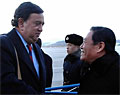
The U.S. has moved to distance itself from the results of New Mexico Governor Bill Richardson’s visit to Pyongyang.
Richardson, who spent four days in the North at the invitation of First Vice Foreign Minister Kim Kye Gwan, returned from the private trip with an apparent North Korean commitment to allow both IAEA inspectors back into the country and the export of its remaining fuel rods, alongside a reaffirmation of Pyongyang’s desire to return to the Six-Party Talks.
“My sense is the North Koreans realize that they have moved too negatively against negotiations; that they have taken some very bad steps and they wanted to move in the right direction,” Richardson said as he arrived in Beijing yesterday.
However, both White House and State Department officials subsequently reacted cautiously in regular briefings, calling again on North Korea to carry out its commitments rather than talking about them.
“We have throughout many months and even many years, dating back to different administrations, seen the words and the rhetoric of the North Koreans fail to live up to any of their actions or their obligations,” White House spokesman Robert Gibbs told reporters, “So, speeches and rhetoric aside, the obligations that they must undertake as part of a respected member of the international community; they’re aware of what they need to do.”
“The belligerent actions that the North Koreans have demonstrated over the past many weeks I don’t think provide anybody the confidence that they’re even remotely ready to resume in a responsible way those talks,” he added.
State Department spokesman Philip Crowley towed a similar line, saying, “The real issue is what will North Korea do. So we’re not going to judge a moment on a conversation between the governor and officials in North Korea. We’ll going to evaluate what to do in the future based on what North Korea does, and we’ve made clear what we want to see from North Korea going forward.”
However, Crowley did offer one suggestion, backing the comment of an anonymous South Korean diplomatic source whereby North Korea should return to the Nuclear Non-Proliferation Treaty.
The anonymous official, speaking in Seoul yesterday, said, “If North Korea wants to accept inspection from the IAEA, it needs to return to the Nuclear Non-Proliferation Treaty (NPT), and in order to come back to the NPT regime they need to freeze and discard every one of their nuclear programs.”
This, Crowley agreed, would be “the kind of step that we would certainly view as indicating the kind of seriousness of purpose that we talked about yesterday.”







