

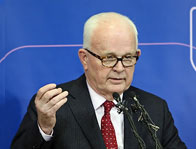
Following the conclusion of U.S. special representative for North Korea policy Stephen Bosworth’s “constructive” attempt to try and kick-start stalled Six-Party nuclear negotiations in Pyongyang this week, the U.S. has not ruled out further bilateral meetings before seeing Pyongyang return to the six-way forum.
The U.S. administration generally seems to be viewing the first set of meetings in Pyongyang with a degree of positivity, though inadequate as far as concrete commitments go. Characterizing them as “constructive,” State Department spokesman Philip Crowley noted in Thursday morning’s press briefing that, ”We did not leave the meeting today believing that they had crossed the threshold that we want to see them cross.”
Speaking upon his return to Seoul, Bosworth said that he had reached a “common understanding” on the need for North Korea to disarm. U.S. Secretary of State Hillary Clinton, speaking after a meeting with the Croatian Foreign Minister yesterday, also gave her support, calling the meetings “very useful” and “quite positive,” and asserting that “making it clear to the North Koreans what we had expected and how we were moving forward is exactly what was called for.”
In the press briefing, Crowley ultimately concluded that more meetings may well be needed, saying, “We await more information from North Korea as to whether and how they will proceed to come back to the Six-Party process. Whether that means a phone call or another meeting, we’ll wait and see…”
For its part, the North Korean Foreign Ministry has also taken a positive stance on Bosworth’s visit. Speaking in an interview with the Chosun (North Korea) Central News Agency (KCNA), an unidentified Ministry spokesman said that the two sides “had a long, exhaustive and candid discussion on wide-ranging issues, including the conclusion of a peace agreement, the normalization of the bilateral relations, economic and energy assistance, and the denuclearization of the Korean peninsula.”
Furthermore, they agreed to “continue to cooperate with each other in the future to narrow down the remaining differences.”
Nevertheless, Bosworth did return from Pyongyang without an explicit commitment from the North Koreans to return to the Six-Party Talks, which a number of experts feared would be the case. For example, writing for Forbes before Bosworth’s trip, Gordon Chang said that if the special representative failed to obtain the assurances that the U.S. government seeks, other would-be rogue states may see it as a green light to act without concern for international opinion. They “will see the Bosworth trip not so much as a test of Kim Jong Il but one of Washington’s word,” Chang asserted at the time.







