

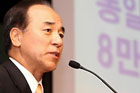
In discussion about unification financial resources, Kim Choong Whan, a South Korean National Assemblyman of the ruling Grand National Party, asserted on April 21 that, “We desperately need international cooperation. The introduction of a Trust Fund for DPRK (TFND) for the reconstruction of North Korea should be reviewed.”
During the National Assembly forum entitled “United Korea and Preparation for the Era of GDP per capita $80,000,” Congressman Kim further declared, “By itself, the South Korean government cannot meet the astronomical costs of reunification. And even if it could, North Korea would not accept such a situation.”
Kim commented that the procurement of financial resources is possible through the assistance of existing international financial organizations, as well as the establishment of the Northeast Asia Development Bank (NEADB). “Loan of funds from the international community,” he stated, “is very important in the sense that it represents acceptance of North Korea as a normal member of the international community.”
North Korea’s unique case necessitates a different and more nuanced approach. While conventional trust funds involve the disbursement of funds to the World Bank, IBRD or regional development banks for the purpose of carrying out development and technical cooperation projects in developing countries, special trust funds were created to provide support to countries that lack membership in international financial organizations. In the past, special trust funds have been integral to addressing issues in Palestine, Kosovo, and East Timor, and could be similarly beneficial for North Korea today.
National Assemblyman Kim continued, “Even if South Korea proposes to raise necessary trust funds required for North Korean aid, it may fail to take a leading role during future unification processes. In order to facilitate amicable international cooperation, social consultation and financial aid within the country are vital.”
Especially, he added, “China will seek to increase its influence on North Korea. To balance this situation, South Korea needs to strive to secure the leading position in developing North Korea. Financial resources for unification must be resolved to continue discussing unification on the Korean peninsula.”
Meanwhile, Chung Yong Sang, the Vice Chairman of the Korea Law Professors Association, Inc., added that, “It is appropriate for the costs of unification to be placed under the responsibility of the nation rather than of any specific group. Therefore, procurement of financial resources through the tax is an appropriate measure.”







