

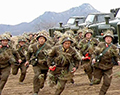
If North Korea has again mobilized its Young Red Guards, a state youth organization consisting of students aged 14 to 16, it represents a serious infringement of the UN Convention on the Rights of the Child (UNCRC), according to a Seoul-based human rights expert.
Professor Lee Yang Hui of Sungkyunkwan University, who chaired the UN Committee on the Rights of the Child from 2007 to 2011, told Daily NK today, “Article 38 of the treaty states that member states should refrain from drafting children under the age of 15. If participants in North Korean military exercises are under 15 then that is a clear and serious violation of their right to life and education.”
“If a child is deprived of the right to education and is not therefore educated properly, then it suppresses their freedom of thought as a child,” Professor Lee went on, before adding, “The result of exposure to propaganda and being dragged into mob psychology is deprivation of the freedom of thought.”
In addition to Article 38, Article 6 of the treaty states that every child has the right to life, while Article 29 states that children should be allowed to use and develop their talents and abilities, live peacefully and respect other people. Therefore, Professor Lee said that North Korea would be in violation of the treaty if it mobilized the Young Red Guards for military exercises, as it is suspected of doing.
According to North Korean defectors, once a child is registered with the Young Red Guards, he or she takes a total of approximately one month per year for training. They are taught how to throw grenades, assemble and disassemble guns and fire live ammunition.
In 1996, when he was 14, defector Hong Chun Il received this month of military training immediately after joining the Young Red Guards. According to Hong, the training occurs at training sites run in each county, and recruits are divided according to their school.
They wake up at 6AM to clean their billets, then spend ten minutes eating. In the morning they are educated in military theory, and in the afternoon receive practical training.
During this practical training, every student is given an AK-47 rifle and taught how to assemble and disassemble it. They are also taught to throw grenades correctly. Hong explained, “In the last section, we were given three rounds of live ammunition to fire at a target 100m away, and the student who got the highest score was given an award.”
Based on historical precedent, the current situation is likely to be particularly acute for the Young Red Guards. After withdrawing from the Nuclear Non-proliferation Treaty (NPT) in 1993, Pyongyang declared a ‘quasi-state of war’, and this brought the children of the Young Red Guards under great pressure.
Defector Kim Sung Hwa from Hoiryeong in North Hamkyung Province, who was in the Young Red Guards in 1993, explained, “Following the declaration, the Young Red Guards, Worker and Peasant Red Guards and reserves were all mobilized for training. There was camping and marches, and school was closed.”
Kim went on, “If there was an order to gather from the school we had to go there with our Young Red Guards uniform on, no matter what time it was.”
Meanwhile, Professor Lee also moved to emphasize the relationship between military activities such as these and poor nutrition, noting, “In a situation where nutritional status is bad, excessive time spent training and performing labor can be a threat to life. It is a clear violation of Article 6, of the right to life, development and survival.”







