

Oh Kongdan of the Institute for Defense Analyses has called on South Koreans to discard their fear and disdain for unification, and show clearly to North Korea that they are ready to embrace “22 million psychologically scarred” people.
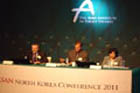
Speaking at the two-day ASAN North Korea Conference 2011, hosted by The Asan Institute for Policy Studies in Seoul, Oh went against the session topic, ‘North Korea: A Cult or a Totalitarian State’, saying that instead of dwelling on the past and on ideology, South Korea and the world must “prepare for the ultimate transition of North Korea.”
“North Korea is not Cuba,” Oh noted, “If I am Cuban, I wake up in the morning thinking, ‘Where is the best burrito? Where can I get inexpensive gas?’ But, in particular if you are in a place on the edge like North Hamkyung Province, your ontological questions are, ‘How can I eat? How can I get pills for my diaorrhea?’”
Oh believes that it is now time to move forward, and that thanks to the flow of information into North Korea it is clear people are now asking questions about their situation.
“It is time to think about how we can move our marble a bit further out,” she explained.
“The biggest thing China ever did is being there,” she noted, offering an example. “The North Koreans are saying, ‘Those guys, who were dying in a famine, we delivered them our rice, and now they are eating pork and chicken while we are dying.’ North Korea is now asking, ‘What is going on?’”
Therefore, she concluded, speaking to South Korea, “Just prepare whatever way you can, and be ready to swallow 20 million psychologically wounded people whose scars will be hard to heal. It’s time for you to do that, Koreans”
Elsewhere in the same debate, however, Dongseo University professor Bryan Myers countered that ideological questions have a great influence on North Korea’s future, and should be a bigger question in any debate about how to approach North Korea going forward.
North Korea has a religious dimension, but is not a cult, Myers explained, harking back to the main theme of his keynote book, ‘The Cleanest Race’. However, he went on, the country’s ideology means that the history of Kim Jong Eun cannot be revealed, for example, instead propaganda relies on a “comically vague” story focusing on the younger Kim’s non-existent “military genius”.
One very pertinent result of this situation, Myers added, is that South Korea must prepare for the possibility of new provocations between now and 2012 from a North Korea “desperate to divert attention from the failure of the strong and prosperous state.”
Myers also added that if and when South Korea eventually faces the problem of ‘De-Kim Il Sungisation’, it will struggle because Kim Il Sung has never been discredited on ethno-nationalist grounds, and therefore post-unification North Koreans may want to keep their statues and may well end up forming a voting bloc.
“Seoul doesn’t have the will to ‘De-Kim Il Sungify’ North Korea,” Myers further asserted.







