

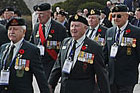
It’s not really the Korean War itself that Bombadier G.G. “Jock” Morton remembers that well, so much as a group of South Korean tourists he met on a plane just a few years ago.
“We were travelling from Auckland to Christchurch,” he explains, referring to his wife, who is not with us on this tour of the War Memorial of Korea in Seoul.
“There was a group of Koreans, a tourist group, and one happened to sit beside me on the plane, you see, so I asked him, “Are you Japanese or Korean?”
“And he says ‘Korean’,” Jock continues. “So I said, “Well I was there in 1952,” and he sort of looked me up and down and then he said, “Korean War?” and I said, “Yeah.”
“And, well, they couldn’t do enough for me! My wife and I got off the plane and they all lined up and bowed and…”
He smiles. “Y’know, I’ve got a lot of respect for them.”
Jock probably didn’t suffer as much as a lot of people in the Korean War, for a number of reasons. First, he arrived in the August of 1952, after much of the most brutal fighting had passed and an uneasy stalemate had set in. Second, he was stationed in head office, known as RHQ. Third, and perhaps most importantly, Jock was quite a sportsman back then.
“I was a gunner when I arrived,” he says, “I was here when the treaty got signed,” referring to the Armistice Agreement of July 27th, 1953.
“But I got transferred out of there,” he explains. “I played a bit of football and I got kept back to play rugby, you see.” He laughs. “So it worked out alright.”
“I come back after the K-Force tour of Japan,” he adds. “I went over to Korea and then came back and played in the British Commonwealth team that toured Japan.” He seems to have rather enjoyed himself. He agrees, “We had a ball…”
Not everyone was so lucky, of course. John Neil Campbell of Hawks Bay, the “fruit bowl of New Zealand” he tells me, is here on this special 60th anniversary trip for one particular reason.
“Some of my mates from Hastings got killed in the war,” he explains. “So I wanted to come back, and get to Pusan cemetery and see their graves… and think about it, you know?”
3,794 New Zealanders served in the Korean War on a force totaling 1,389. The first of them, on two frigates, was dispatched on June 29th, 1950, just days after the North Korean invasion. The group, known as K-Force, would serve in one form or another in Korea until 1957. 33 of their number were killed, 79 were injured, and one was taken prisoner.
Two years later, the blink of an eye in the context of our conversation, Jock arrived back in New Zealand. It was June 9th, 1954. His 24th birthday, as it happens.
“You must have had a few beers that night!” I suggest.
“Actually,” he adds, recalling the time, “we were coming over on the ferry from Wellington to Christchurch and we wanted a few more beers. But the joker in charge wouldn’t give us anything! Anyway, we got a bit annoyed with him but he won.”







